|
Soldier's Stories Recollections of
WWII |
|
We are going to start to collect and print some of the personal recollections that many of you have sent in. Most of these stories have appeared in previous Mail Calls, and are just being reprinted here. We are not going to do any fancy editing here. The words speak clearly for themselves.
We look forward to receiving many more stories from you all. Send your stories to Ben Barrett at: mailcall@517prct.org
Bob and Ben Barrett
Subj: August 15,1944 - Jump into Southern France
Date: 11/26/2001 5:49:54 PM Eastern Standard Time
From: Joe
Mackiewicz
Ben, I can vividly remember the morning of August 15, 1944 when we jumped into Southern France. It seemed that no sooner than I got the opening shock from the chute opening I was in the tree tops. It was black as hell and I couldn't see anything nor did I hear anything. There I was hanging in the trees and wondering what to do next. I spilled my reserve. (It was white - the main canopy was camouflaged.) The reserve seemed to spill out and down to about what I thought to be about fifteen feet down. In my anxiety to get the hell out of my predicament, I took my jump knife and began cutting the shroud lines on my main chute. When I got down to the last one, I realized that this is not what I should be doing. My intention was to pop the release and climb down the reserve. Well to make a long story short , I cut the last shroud line and prepared myself to fall ten or more feet to the ground. Well guess what, I only fell about six inches and was on solid ground. WOW what a feeling that was. Then to make matters worse, I lost my trigger housing group to my M-1 and couldn't find it right away. I searched around for almost an hour before I found it, it was dark and I was scared all to hell. Incidentally, the reason the reserve fell so far is that the tree was on the edge of a terrace and it missed the edge going down. That was only one of many times that I was scared to death.
Joe Mackiewicz
The Story of the Lost Dog Tags
I don't know exactly where to start. This story has been around a bit and I think that I have read two versions on your Mail Call. Where they came from I can't be sure. I know the Museum in Loveland, Ohio has info about the story and the Albuquerque Journal printed a piece on it, but what I have read on Mail Call isn't exactly right, so let's start from the beginning.
I did hit the ground hard in total darkness and along with a few other boys found the company about noon. We got into a tight spot near Les Arcs, and dug in near a house and watched the Germans massing in the valley below and expected the worst until our mortars and artillery swamped that valley at about 5:30. We had been under fire for two or three hours, but after those big shells cleared the valley, the battle was over. We were extremely tired, so we dropped to the ground around the house and slept. I soon missed my dog tags and got new ones. In 1978 Fred and Colette Sayes, who live in the house, were cleaning their yards when Colette had my dog tag grab her rake. Much later I learned that she called it a small metal plaque. They tried to find me in the Draguignan Cemetery and by writing to the address on the tag. No success so they placed it in an envelope and placed it in a drawer.
In 1989 a group of 517 vets returned to the area. Among the group were two men who knew me, Ben Adams and Dick Jones. The group were hanging out in the plaza in Les Arcs, when Fred Saeys approached Ben and asked, "If he, per chance, knew Eugene Brissey". Ben said "yes" and called Dick. Fred told them that he had Eugene Brissey's dog tag. They talked, took pictures, and Fred gave them his address. When they returned home they called me. I wrote to Fred and after several letters it was apparent that they wanted to keep the tag, which was OK with me. I requested that they send it to me so that I could see it. With some reluctance, perhaps, Fred said that he would send it because "it would be more special to them after it had been in my hands". I kept it a few weeks and I suspect that they never expected to see it again. I sent it back stating that I wanted them to keep it because I had it for about 14 months and lost it while they had kept it safe in a drawer for about 11 years. They then informed me that the wanted to return it to me. Then they urged my wife, Edie, and me to visit them, saying that the wine was fine in October. After considerable thought we accepted their invitation and met them in Nice on Oct. 21 1990 and within a few minutes we were relaxed friends. We met several of their friends and a few French vets. They took us on tours through our battle grounds. They then presented me the tag in a brief ceremony at their home. During our stay, Nice newspaper reporters came to their home, took pictures and wrote a story of the "Saga". It was an unbelievable chain of events. They are great people and we had a very special five day visit.
-- Gene Brissey, March 6, 2001
Dear Ben:
Fred Beyer sent me this message about Frank Dallas. Several of my acquaintances credit Frank with saving their lives with the keen eyes and quick reaction to a disastrous situation. Fred didn't send you a copy so I'm passing it along for those who may be interested, including Frank's family.
"I can only think of Frank Dallas, Sgt. Dallas. A few days ago you wrote a piece about Sgt. Dallas killing five Germans and wondering about how much ammo he had in his rifle. His first shot was from his 45. I was with him at the time. That night he said, 'Beyer, you and I are sleeping out on the point tonight.' We went out and piled some brush around us and went to sleep. In the morning we got up and to our surprise a German was coming at us. I guess he was just as surprised as we were. My rifle was on the ground by my bed roll. I couldn't get it quick enough but Sgt. Dallas had his 45 out and shot him. Then looking down the road, we saw five Germans around Capt. McGeever's and Pvt. Woodcock's bodies. This is when the Sgt. started shooting them. In the meantime, a patrol of Germans was coming up along the side of the mountain. Our platoon took care of them. When Sgt. Dallas shot the first one he saved me cause I couldn't get my rifle fast enough. From that time on, the one that came at us, that he shot, was known as the bread man, cause he had a loaf of bread under his arm. I hope Col. Dallas's son or wife reads this to him. I am sure he will remember the bread man. Fred Beyer"
Howard Hensleigh
Subj: Pearl Harbor Day
Date: 12/7/2001 1:14:34
PM Eastern Standard Time
From: Roy Herren
To: Ben517
On DEC 7.1941 I was a new 23 day (one year draftee). Just got drafted on the 14th of Nov. 1941. They hauled us out of bed at 3:00am in Camp Croft, South Carolina and issued us full field packs and ammunition M1's and Enfields. Hell ! I didn't hardly know what to do with it. Eat it or make love to it. Scared to death. We were all green as Hell. They thought they were going to invade the East Coast too. It was my birthday present as I was 22 on the 5th of Nov 1941. Also my younger sister was born on that very day Dec. 7.1941
From The Sunny south,
Roy Herren
Subj: Santa Rosa Trip
Date: 12/13/2001 2:23:32
PM Eastern Standard Time
From: Gene Brissey
Ben, those of us who shared the ship with WACS obviously have a few stories, especially if we were lucky enough to have a lady to share the long days at sea. Those who did had little time to go to the ships store to buy gum, candy, etc. So my good friend Roger Bender and I went into business. With five dollars each we bought about 300 items at three cents each and strolled the decks selling them for five cents each. This business continued for about 12 days resulting in a profit of over $100.00 for each of us. Those young folks sure liked to chew and eat candy or what ever else we could find to eat. Too bad we couldn't sell blankets because the cool night air must have been uncomfortable.
Gene Brissey
Subj: Re: MAIL CALL NO. 204 517TH PRCT
Date:
12/25/2001 1:39:24 PM Eastern Standard Time
From: Howard Hensleigh
Dear Ben, It is Christmas. Although our thoughts are with our loved ones close at hand, we see service men separated from their families, as we were in 1944. Our thoughts are also with those Belgian families who were driven from their homes on that Christmas. We came into one home where Christmas preparations had been made, a cake on the table. Although we ate the cake with relish, it was with mixed emotions -- sadness for the family who had left it behind. We hoped they would survive and return for many family Christmas reunions, with a look upward and thanks for the outcome of the battles that lay ahead. We trust that they are there today surrounded by loved ones rejoicing the miracle of Christmas. For those younger generation 517ers, I will try to express the satisfaction we older generation members have in the fact that you are interested. Each soldier was a part of a unit, a squad, a platoon, a company, a battalion, a regiment, and the whole darned Army (including the Army Air Corps). Then there was the Navy, all participating in the effort to make a better future. Each one of us was a small peanut in a big bag of peanuts. Sometime we knew what was going on and sometimes we just followed the man ahead of us, hoping that the guy in the lead knew where he was going. Sometimes on the trucks in the Bulge, we were so cold that time stood still. A glance at a watch found that the hands had not moved and it was a long time 'till morning. When we were in combat our view was limited to just what we could see. We didn't expect anyone to see what we did in the face of withering fire. Sometimes we were awarded for our acts of courage, and most of the time we were not. There was too much to do to be concerned about that. What we had was the respect of our buddies. That was enough. Least of all did we expect those at home to know what it was like, or to appreciate it in a detailed understanding way. When we got home there were the celebrations in New York. But, the American civilians could not understand us as well as the European civilians, and we didn't understand them. Was it really a hardship to go without nylons, so we could have parachutes, and to be limited in purchases by rations books for everything from gas to food? Now, after over fifty years, they are building monuments in Washington and even places like Des Moines, in recognition of our contribution. Books like the Greatest Generation add to that. One of the most gratifying recognition's though, comes from you younger people who are interested in a detailed way in what your fathers, brothers, uncles and their buddies accomplished. You have thanked us; now we thank you.
Merry Christmas
Howard Hensleigh
Subj: Mail Call No. 164
Date: 10/12/2001 4:49:00
PM Eastern Daylight time
From: Mike Spano
To:
Ben517
Ben, You asked for personal stories. Here's one I will never forget. I know that thousands of eerie events happened to lots of guys that made them believe in a guardian angel. Here's mine.
It was in Manhay. I was with I Company, Third platoon. We led the attack and were right in the middle of our own massive artillery barrage. That night we all jumped into already dug foxholes. The next morning, one of the guys in the foxhole only a few yards away asked me if I would switch foxholes with him. Can't remember his name, but he was a B.A.R. man. Without hesitation I said "sure", and made the switch. It was late morning, I believe, when a P38 lightning flew overhead. Because of its twin fuselage, it was one of the few planes I could recognize, so I jumped out of the foxhole to take care of a personal matter. Suddenly, the P38 dives and drops a 500 pounder. I dove back in the foxhole. That's when I heard that awful scream. I popped my head up just in time to see the guy with whom I had switched foxholes running with no right arm. Just shreds hung down from what remained of his shoulder. I slumped down in disbelief. If I didn't switch foxholes with him, that would be me. Neither he nor his buddy survived just that one bomb. Friendly fire did it to us again. For quite some time I suffered what is called survivor's guilt. Manhay wasn't the only rime my guardian angel was looking after me. I'll tell you about another incident in which I was shot when leading an attack as pointman at a later time. It boggles my mind. Incidentally, if the trooper who was with me in the foxhole is among our members, please write me.
Mike 517
Date: 10/13/2001 10:00:42 AM Eastern Daylight
Time
From: Fred Beyer
I was in Manhay, and will never forget the artillery barrage the night before I lost my arm from that P38. It could be the one you are talking about. I was in a foxhole with Cleo Browning and believe he was killed. I do remember that Lt. Stott was killed that night.
I don't remember any one named Mike off hand. Refresh my memory, will you?
Sunday October 14, 2001
Fred Beyer
Date: 10/13/2001 10:51:06 PM Eastern Daylight
Time
From Mike Spano
Hi, FT Beyer...
I was astounded to hear that you survived the P38 attack. When I saw you running, I thought you would never make it with all the blood loss. God bless you. It was either you or your buddy who switched foxholes with me prior to the attack. Do you remember? Believe me, the switch happened. Was it you or your buddy who was the B.A.R. man? Please let me hear from you. However, we are driving to Florida tomorrow to our winter home and need a week to get my PC turned on there. I can't believe it. All these years I thought you were dead. I don't think we knew each other very well, so I didn't expect you to remember me when I couldn't recall your name either. But I'll never forget the incident. I was in the foxhole next to you.
Mike Spano
Date: 10/19/2001
From: Bill Gearon
Subj:
Manhay
I related the story of Mike Spano and Fred Beyer to my uncle, Lt. Ray Gearon. He remembers the incident with the P38 and the losses from the friendly fire. He was the platoon leader of the 3rd platoon, Co. I, 517th, and Lt. Stott ("Stozie" he called him) was the platoon leader of the 1st platoon. He relates that when it came time to move into town, the shells were coming in very heavy and falling short. My uncle wanted to wait, Lt. Stott did not. Stott left and my uncle followed him about a minute later. When the third platoon caught up to the first platoon, he found "Stozie" dead. He recalled the P38 dropping the bomb and strafing the encampment.
He related a story about Lt. Stott. They were in Nice and a number of children with no money were watching others on a merry-go-round, unable to participate. "Stozie" bought a roll of tickets and he told the operator that all of the children could ride.
My uncle also related another story. He had a man in his platoon (he could not remember his name) that always complained that "he was the last man in the last squad, in the last platoon in the regiment, and the first to go out as a scout."
God bless you all!
Bill Gearon, nephew of Lt. Raymond D. Gearon
From Howard Hensleigh
Tom Cross articulated what all of us feel about Mail Call. The fact that Dick Seitz, Bill Boyle and he are still with us and with it, provides some of the original leadership of all three battalions. Tom's original connection was with the 2nd, but from our last stay at Joigny he was CO of the 3rd. Mel Zais and Forrest Paxton both bowed out early for the 3rd. Col. Graves hung in there for a long time. The 460th is well represented although we lost Cato somewhere along the way. Bob Dalrymple has been there for the Engineers.
As always, the outfit has not been lacking in leadership springing up whenever it was needed, both in combat and in peacetime. When Frank Longo and I came back to get our jump casualties, we entered a small Southern France village. The German burp guns let us know they were still there. A couple of paratroopers who hadn't found their unit moved down the street with a bazooka. The next thing I heard was the "blam" of the bazooka and that was the end of the burp guns. These guys were fighting their own war and for the moment providing their own leadership. That is the way it was and still is with the outfit. Leadership in small or large groups has always been there when needed.
From Howard Hensleigh
I have read Band of Brothers. I recommend it to anyone who wants to know how it was. Although about a different outfit, it will strike home for all 517thers and will be a learning and understanding experience for those of our extended family.
After going through the Bulge again with those Screaming Eagles, I appreciate a warm house and clean sheets. In the middle of one of those cold, endless nights on open trucks taking us to another hole in the dike in the Bulge, we looked off the side of the truck and saw the most miserable hut with some smoke curling out of a make shift chimney. You could imagine that if the guy had anything to eat it would be thin soup. One of the troopers in appreciation of this sight said, "There must be the happiest man in the world". This is humor only Bill Malden and the rest of us dog faces could understand. To be warm and dry on a night like that would be nothing short of heaven.
Date: 1/13/2002 12:20:34 PM Eastern Standard Time
From: Howard Hensleigh
Here is one for Tommy Priest if he is out there somewhere. His two stalwarts [William] Webb and JK Horne were laying wire. Webb saw some Jerries and grabbed his M-1, leveled it and was asked by JK what he intended to do. He replied that he could shoot a couple of Germans who were within rifle range. JK said that if he fired the Germans would fire back and they wouldn't get the wire laid; Lt. Priest and Captain McGeever wouldn't like that. They laid the wire and saved the day, communications being one of the chief elements of organizational coordination. We know that the infantry's job is to close with and destroy the enemy, but sometimes the primary mission takes priority. I got this story straight form our friend Webb at one of our reunions. He led me to believe the communications section was well instructed by its leaders.
Date: 2/1/2002 12:30:06 PM Eastern Standard Time
From: Howard Hensleigh
Dear Ben,
This is a response to one of the sons or grandsons who had read Battling Buzzards, wondering what we thought of it, and queries from Tom Reber about the accuracy of the aid station account mentioning his Dad on page 273. During the War, we knew we were doing something special. We realized that no one would ever know how it was without going through it as we did. I wasn’t sure anyone would take the time to attempt to lay it out in a book. Because of that I have appreciated any author who made the attempt and am particularly appreciative of Gerald Astor. First, this is an excellent book written by a dedicated author who took the time to interview many of our members. He no doubt accurately reported what they said. In general he got things right. However, whenever I read an account of something where I know the details or the people well, I frequently find discrepancies. In associations with people throughout our lives we run into soul mates. In the Army we called them buddies. Dan Dickinson and I spent hours together in combat and for example in a 40 & 8 on the ride from S. France to N. France. There is no way Dan Dickinson would have listened to a braggadocios Kraut with hand injury with Bob Reber standing in line waiting his turn for medical assistance. Nor, do I think Bob was able to stand or lean against a pole. When we carried him down the hill on the door of a Belgian building, I wasn’t sure he would make it to the hospital. Some of you who saw him in Chicago struggle to his feet, refusing assistance, on the dance floor after receiving an award, might believe that in spite of his paralyzing injuries, he would have pulled himself up and told Dan to patch him up and send him back to his mortar platoon. He was that kind of a guy, but I don’t think he was capable of that until he had a lot of VA rehab.
Another of my buddies was "Woody" Woodhull of the 460th. We patrolled together many times in S. France. After a successful combat patrol, Woody would call in artillery to finish the job and keep the enemy troops from deciding to follow us as we withdrew. He was killed by a burst of machine gun fire not more than three feet from me at Bergstein. We were doing our "damnedest" to assist the attack with artillery, probably a little too far forward for an OP, which was usual with Woody. Red Meline and I directed artillery fire to wipe out the machine gun nest after his death. His radio man, I believe a Sgt. Riddle, previously was wounded in the lower leg by a burst of the same gun. That burst went between my legs miraculously not even nicking me. He was standing just behind me and was evacuated. Woody and his observers weren’t killed by mortars as reported on page 292 of the Book, and Woody was the only fatality. Gerald Astor got the drift of Bergstein, which was a heart rending diversionary attack – our last taste of combat and a bad one. A diversionary attack is just that though – an attack to fool the enemy into thinking your main thrust is from one direction, when you really intend to get him from another. If you tell the attacker to put on a good show and not take too many casualties, it probably won’t fool the enemy and won’t be successful. In an attempt to remove some of the bitterness we feel in our enormous losses at Bergstein, personal as well as organizational, we must credit ourselves with the fact that it was a successful diversionary attack. When that outfit swept in from the right with tanks and artillery, they rolled. They rolled because of what we did in that diversionary attack.
Howard Hensleigh
Subj: Santa /Rosa
Date: 1/29/2002 5:36:14 PM
Eastern Standard Time
From: Hal Roberts
Ben,
The way I remember the dead-in-the-water
episode is like this. The convoy was gone and we were on deck with life jackets
on. The nets were over the side and they said that there was a sub in the area.
On the horizon I saw three black spots which became streams of smoke and then
they were on us and around us . They were doing figure 8's off our stern with
depth charges being launched. Soon the ocean had water columns going 50 ft up .
They then broke away and the word was ALL CLEAR and I thought ------'those damn
sailors aren't so bad after all' .
Subj: Re: MAIL CALL NO 119 517TH PRCT
Date:
1/22/2002 5:32:25 PM Eastern Standard Time
From: Howard
Hensleigh
Note to Al Sperry -- Your story reminds me of two things: Make up jumps at Mackall and Lille.
At Mackall just before we pulled out for Patrick Henry, there were a number of troops who hadn't gotten all the jumps in and wanted to make up for lost time. These were what we called glamour jumps with no equipment and no problem to follow. We jumped one morning and many of us were on the ground, including the riggers who had packed the chutes. One man jumped and his chute did not open. His descent accelerated and we all started yelling "Pull your reserve!!", especially the riggers. He did pull it and his chute opened when he was just a few feet from the ground. I thought he would be injured, but he was not. I figured out later what happened. His chute popped open and the strain on the risers caused them to stretch down. They were stretching back up when he hit the ground giving him a little extra lift and a softer landing. I don't mean to say it was soft, but it wasn't quite as hard as it would have been. I took the guy back up and jumped him again so he wouldn't have that jump to look back on when we jumped next, which happened to be in combat. I'd like to know that man's name too.
Lille may be remembered to you as the place you befriended a telephone girl. If you remember, that tent camp we were in outside Lille was where we prepared for a top secret mission. There was barbed wire around the place and armed guards instructed to shoot anyone trying to get in or out. They trusted me to go to Brussels for a truck load of beer at a brewery run by the Brits with all the work done by Belgians. I had the right papers and got the load of beer back to camp without sampling it on the way. The Allies rolled past our intended drop zone and the prize scientists we were to capture for return to the States. I was never sure whether they were jet engine experts or the ones who invented the buzz bombs that devastated London and Antwerp. At any rate, this freed up the outfit to take turns to visit Lille.
Here again they trusted me to be in charge of the MPs in town. Officially, Capt. Bill Young was in charge, but we never saw him from the time we got there until we pulled out. The MPs were not really MPs, but just 517thers with MP armbands. Our guys wouldn't pay any attention to an MP who didn't wear jump boots. So there we were. The trucks rolled into town at noon and left at midnight. Our job was to see that the boys did not tear the place apart. I had a jail and keys to it so it could serve as a temporary lock-up. It was underground and resembled a mediaeval dungeon. Everyone was really pretty good. The bars, dance halls, and other establishments of entertainment flourished. I watched the trucks unload so I would know who was in town.
There was a guy named McQuade form I Company who was one of our best men in combat. In some of the Southern France attacks he helped cut a hole in enemy lines to allow I Company to get on with its mission without severe casualties. He shot Germans like he shot rabbits back home, and he loved to hunt. The were stories that a judge in Chicago let him out of jail if he would join the paratroops. Paxton never approved a medal because of his out of combat extra curricular activities. When he had a few drinks he didn't know who was the enemy. He shot an Italian in Italy and was saved by Mel Zais just before the jump into S. France, as is covered in Battling Buzzards. Zais put the fear of God into him by telling him that if he got into any more trouble Zais would skin him alive and drum him out of the outfit. This was a real threat to McQuade, because he loved the outfit. It was honorable, patriotic work and he loved being with his I Company buddies who were somewhat in awe of him.
When I saw him get off the truck, I alerted my MPs to keep an eye on McQuade and to bring him to me before he got into serious trouble. At around 1500 hours two of my guys brought me a very drunk McQuade. He had just started to tear a bar apart. I took him down to the dungeon and locked him up. He was mortified and unashamedly crying. I left him there until about twenty-three thirty when I let him out and took him back to the trucks. I told him that I would not prefer charges against him and made a friend for life. The next time I noticed McQuade was when the high point men marched down to the train in Joigny. The route to the train was wet with McQuade's tears. He was crying his eyes out because he didn't wasn't to leave the outfit. With the War over, the I Company C.O. moved this combat hero on to some unsuspecting 82nd Airborne CO and as far as I know, none of us ever learned the rest of the McQuade story.
That wasn't the end of the Lille story. The War in Europe ended while we were there. Everything in the town stopped to celebrate the victory. The Marselle was belted out from the town square so that it could be heard all over town; it played non stop for three days and three nights. The street car operators stopped their street cars right where they were in the middle of the street, got off and joined the celebration. Farm families walked into town sometimes pushing wheel barrows full of farm produce to be shared with city relatives. Every one loved us and for once it appeared that some of the French actually appreciated what we had done in liberating the place.
Subj: My Favorite Belgium Bulge Snow Story
Date: 1/18/2002 12:14:28 AM Eastern Standard Time
From: Gene
Brissey
I've seen several good stories about our time overseas so, decided to send one.
In mid January 1945 some where between Trois Ponts and the Hunnage and St. Vith area we were struggling through the snow toward a forest. We were in groups by battalion or company. In any case when we approached the forest we formed into platoons and entered the forest. It was completely dark and with a few bullets flying around we became separated and our platoon, in single file stopped and tried to figure out what to do next. I was following the platoon leader who stopped us and directed me to hold the platoon in place until he found the other troops. He took off and never came back. After 30 minutes or so while a few bullets were still flying overhead I heard troops walking to our right. I had no way of knowing who they were but after a few more minutes I told the trooper behind me to pass the word back that we were moving out but not to tell them that we had been deserted. I walked forward a few yards and almost fell into a trench which had been made by the troops going by in the deep snow. I felt that there was but one logical assumption to make. This "trench" was made by our troops. Since it was pitch dark I could only lead the way by feeling with my feet and legs. We walked this ways for a long time. Dawn finally came and we could see the tracks. We began walking fast and soon caught the troops ahead of us who were ours.
Immediately words were passed back asking if the third platoon was back there. "If so send them forward." We went up the line until we found a couple officers who ordered us to go into the forest to determine if there were any Germans. About a hundred yards later we encountered a bunch but could barely see them because of the dense forest. We had two guys in the platoon who could speak German. We started to negotiate. Neither side would surrender so shots were fired and all hell broke loose. We chased them out, didn't capture any and never found any bodies. We regrouped with the outfit and moved a short distance and dug in. Shortly thereafter I received word to report to some officer who wanted to give me a snow suit. I told him that some of the troops did not have a suit. "That's OK " he said, "after what you did this morning I don't want to lose you." He didn't say a word about what I had done and I never ever heard another word about my favorite Bulge "snow go."
Gene Brissey
Subj: Recollections
Date: 2/16/2002 11:33:27 AM
Eastern Standard Time
From: Gene Brissey
During those long weeks overlooking Sospel, my squad and I were on forward outpost for 30 days. We had turned our slit trenches into nice under ground condos. I even had a straw mattress and a phone in mine. We were located between Col de Braus and Luceram. We would make frequent patrols to the Col de Braus area to make contact with the troops on hill 1098, Col de Braus or wherever in the heck they were. We were shelled daily but the only casualty was a squirrel which I shot while on patrol. We boiled it in a tin can but I didn't get a bite. The squad members ate it all before I knew it was cooked.
Since those long ago days I have visited Col de Braus and the Sospel area twice, the last time was 1999. It's much the same, a few destroyed buildings just as we left them in '44. There are a couple new spots placed there, no doubt to grab some tourist money. That road up to Col de Braus is still a series of curves or switch backs but a lot easier to maneuver than back then. You can see a good picture of that road in the last THUNDERBOLT. John Krumm Jr. and his wife and my wife and I made the '99 trip. John and I wanted to find that old outpost site so we turned on a logging road and traveled to Luceram. On the way we found the outpost where his dad and we other squad members spent that long 30 days. The remains of our "condos" were very evident, still shallow trenches and many rusted ration cans. That brought chills up my back! Many stories could be told about that period but not now.
Gene Brissey, E CO.
Subj: Recollections
Date: 2/16/2002 11:33:27 AM
Eastern Standard Time
Part of Mail from Howard
Hensleigh
Welcome aboard to Herb Jeff, Jr. Please don't think I have total recall. Some of this was refreshed at Ft. Benning in a conversation with Herb, but I do remember the incident clearly. We were in Pierra Cava, I believe. Herb Jeff was Woody Woodhull's right hand man in relaying artillery adjustments to the 460th gun crews over his radio. Col. Cato put out an order stating that all the radio men would also be orderlies for the artillery liaison and observers. I really don't pin this on Col. Cato, but one of his staff probably had the bright idea. Herb approached Woody and told him from then on he could carry his own d-----d radio. Woody sensed the difficulty and told Herb that they would continue as they had in the past -- satisfactory to both. They were a team anyone would like to have on a patrol and they were always with us. Not only did they help us accomplish our missions, but if the Germans were on our trail as we withdrew, they kept a few rounds between us and them. One thing I didn't know was that he and Woody often discussed how great it would be to be in the infantry and be entitled to wear a Combat Infantry Badge. Those guys deserved one. When we meet up, I'm going to make Herb an honorary member of the "Queen of Battle".
Howard Hensleigh
Subj: About Your Grandfather Max
Long
Date: 10/31/2001
From: Gene
Brissey
Dear Kristen:
I read your notes in the 517th Mail Call. As I write this, I have before on my keyboard a great picture of Max Long of Company E, who was a friend and also in my squad. If I had to pick out one man as a model for a paratrooper, I would pick Max Long. he stood tall, straight, and strong. He was pleasant, a good friend and a great soldier. I don't know where to start or where to stop, but I will try.
I met Max in our early training period. we were in the same squad of 12 men in the third platoon of Company E. we were together from training camp to a cold and terrible day in Belgium. Please let me work up to that end and be as brief as possible. Of course, Max and I shared the same barracks and we boys would sometimes have fun boxing matches, with large 16 ounce gloves. One day Max and I were having a friendly match, which wasn't very wise of me because he was much larger and stronger. We were doing OK until he hit me in the left temple and knocked me flat. this, of course, caused NO hard feelings between us. We trained hard and he became a machine gunner and I eventually became a squad leader with him in my squad, I am proud to say.
We went to Italy in May 1944 and were in combat around Rome for a while. then we jumped into France on August 15th 1944. Max and I were in combat there for 43 straight days. we were then sent to Northern France for a rest and Christmas party in early December 1944. the rest was short because the Germans broke through in the Ardennes in Belgium. Our outfit was sent immediately to fight in the battle of the Ardennes, which became known as the Battle of the Bulge. We were in horrible weather and terrible combat. Max and I, with the 517th, moved forward as we drove the enemy back. One memorable night, we were near the front lines and were permitted to make beds for the night. Beds were any combination of materials that we could get our hands on from the load of stuff dumped from a truck in our midst. we slept for a short while and then told that we had to go farther toward the front and that we could carry our beds with us if we had the strength. Max, being a machine gunner, could not carry the gun and "bedding", so I told him to take the bedding and I would take the gun. He objected, but as squad leader, I insisted and he grabbed some bed stuff and I took the gun and we stumbled through the snow for an hour or two until we were told to dig in again. Max started digging into the snow and some young man came up to me and gave me a little bed roll.*
Max and I decide to bunk together as we stayed alert for action if we were needed. Max took his boots off and we went to sleep. the next morning we were completely covered by snow when we were told to get up and move out toward the front. Unfortunately, Max found that his boots were frozen and he could not get them on. we worked for several minutes to warm and soften them. He finally got them on and we moved to the front and into battle. In the afternoon, we were in a forest when a large German artillery shell burst in the trees above us. I was knocked out, but not hit by any metal. When I woke up, Max was beside me with a large ash down his right shoulder and back. The shell burst also wounded Lt. Quigley and several others.
I never saw nor hear from Max again. I was able to continue and help liberate Belgium, and moved into Germany where, on February 8th, in the last battle of the war for the 517th, I was wounded. I never returned to the 517th or to another company after the 517th was reassigned to other paratrooper units.
Sadly, I heard a few years ago that my good friend Max had passed away. This is very brief and does not nearly cover the experiences that we had. If you have any questions, please feel free to contact me.
Gene Brissey
* What followed was one of the "warmest" things that happened to me during combat. As I stood there wondering how I was going to sleep, the company radio man came up to me and said, "I saw what you did back there and I brought you this." He handed me a small sleeping bag which was the warmest thing I had ever seen. [...] We moved on but the memory of that young man bringing me that sleeping bag will never move on from my memory.
Date: 11/3/2001
From: Gene
Brissey
Ben,
As jokes sometimes do, a story in Mail Call usually reminds one of a similar story. Reading Howard Hensleigh's story about sleeping in a house brings back two of my sleeping-in-a-bed stories during the Battle of the Bulge.
First, I slept in a great bed in Trois Ponts for two nights. During this time we requisitioned steaks and butter from a butcher shop. Cooked in butter, those steaks were even better then tan?in ones. Next, when we entered the village of Hunnange (now called Hunningen), our platoon leader assigned each squad a street with instructions to clear the houses and then we could pick one in which to sleep. I took my squad to the first house on the street where a sliver of light was showing from a window. I told most of the squad to go to the rear of the house and two other men and I would chase the Germans from the house. With the two men backing me up, I knocked on the door. the door flew open and a big guy jumped out and grabbed me. I thought that I was in trouble for a spit second until a woman jumped out, grabbed and hugged me. I immediately told the squad that we would spend the night here. the Belgian family fed us fried potatoes, the only food they had. We gave them some of our rations and prepared for sleep. We were in their basement. I went to the first floor bed room and crawled into a beautiful bed. However, this did not seem like a good place to sleep, since the Germans were shelling the village from the St., Vith area. I retreated to the basement and slept with whoever could get in there. The next morning, four of us went out to see what we had failed to clear out. A group of women were screaming "Bosche", or something like that and pointing to a nearby basement. we went in and captured a German officer and seven men and a radio vehicle. the officer wanted to go to the vehicle. we finally let him do so. He reached in and pulled out five bottles of schnapps. May not have spelled that right, but we knew it was German booze. We tried a little of it and sent the Germans to the rear and soon joined the tanks and headed for St. Vith which was a mile away. The enemy cleared out. I think though, some other outfit went into town and we took off for Stavelot for three or four days of rest. the Bulge was straight again.
Gene Brissey
Date: 11/2/2001
From: Howard Hensleigh
Re: Sleeping Bags
When I read Gene Brissey's account about the care we took of each other and the sacrifice, it stirs my own memories on the same subject, with a slightly different twist. Some of the things that happened are a bit brutal, but in the context of what we went through, they are understandable.
Grant Hooper borrowed my sleeping bag in that snow-strewn attach south of Stavelot which lasted several days. This was unusual, but I let him have it. We were in the cellar of a house to lessen the effect of the artillery fire. Without a sleeping bag, I said to hell with it and went upstairs, took my boots off and slept like a baby in a big bed with a warm set of bedding. That was the best night's sleep I got during the whole Bulge. I had to patrol early next morning. By night, the outfit had moved out on the attack. I went to Hooper expecting that he had recovered his own sleeping bag by then. He had. I asked him for mine and he said he expected me to come around to where he slept and pick it up. From then on, I slept somehow without a sleeping bag. In Manhay, there was a badly wounded German lying in the street. He had a blanket and lasted for several days. We didn't try too hard to get him out because the SS bastards put our meat wagon under artillery fore whenever we evacuated casualties. On the third or fourth night Red Meline came to me and said that the German had died and gave me his blanket.
That I remember this today means that I really appreciated how considerate Red was. Warm feelings for Hooper, though, didn't materialize.
My best to all,
Howard Hensleigh
Date: October 1, 2001
From: Randolph
Coleman, Company Headquarters, 2nd Battalion, F Co,
From the beginning, April of 1943 to the fall of 1944, I was a proud member of this gallant company of heroes. I still am proud. I'll never forget my first day at Camp Toccoa when then Major Sietz told me "We take you in as boys, and send you home as men". Further checking me out, he asked me what I would do if he ordered me to punch a hole in his office wall. I, without any hesitation, said I would do it. I guess he thought if I was crazy enough to do that, I would fit right in. Some things I said or did yesterday, I forget... but, I have not forgotten anything from 1943 to 1945!
Thanks for the memories and God Bless you all.
Randolph Coleman
Date: 12/24/2001 2:00:16 PM Eastern Standard Time
From: Jim Mortensen
Boom Boom [Alicki]'s comments about Joe Brown caused me to dig into my library.
Our forward observation group included a radio operator named J.G. Ward Jr. I think I may have tracked him down though I haven't had a response from the address you gave me, Ben.
We had a rifleman attached to our small group as we
crossed those damned mountains on the way to Col de Bras. Though I can't recall
his name, I'll never forget the day we were resting behind a farm house about
lunch time. There wasn't much to eat! All of a sudden we heard this big todo and
I heard him yell "get out of here you sonsabitches," and out he came with 3
German prisoners in tow. He was armed, since he was out hunting chickens not
soldiers, with only a trench knife! We never got over it.
Mentioning Col de Bras brings back another memory and then I'll quit. My forward OP (and my daytime residence) was a stack of stones on top of the mountain. It offered a sweeping view of the valley below. Nothing could move without my seeing it. It was a long hike straight up from the cave at the base. I'm sure you remember the cave if you were in the vicinity. It was near the road and we called it home in between passes to Nice. Anyway, most mornings began with a duel between one or more of our 75MM howitzers and the mortars hidden in the fortified mountain just across that funny saddleback. It was sort of routine. The 75's couldn't do much damage to the concrete bunkers but it scared the heck out of them. Their mortars had a hard time zeroing in on my fortress. Then, one morning they got a little closer and started dropping rounds just behind me and, all of a sudden one hit the edge of the pile of stone. There was no time to duck and I heard a lot of steel go whizzing by my exposed head. Unhurt, I began to look around and picked up the binoculars which had been hanging around my neck so I could try once again to find that doggone mortar.
The glasses didn't feel right, and they didn't see right either. The upper lenses had been cut off as neatly as if someone had taken a jeweler's saw to the job! By my calculation I missed losing my heart (instead of my 7X50's) by about 3 1/2 inches. I couldn't find a trace of the glass or anything else. Lucky day.
I drove through Col de Bras many years later and had a chance to look at that fortified mountain of theirs. It was a mini-Maginot line! Anyway, it reminded me why I was not unhappy when we started down the mountain, went across the valley and on to greater glory in the Bulge.
And HAPPY HOLIDAYS TO ALL!
Jim Mortensen
Date: 2/15/2002 7:11:40 PM Eastern Standard Time
From: Howard Hensleigh
Ludlow Gibbons gave Mr. Astor a brief account of his and Mel Zais’ encounter with the Rangers in Paris. It appears on pages 299 & 300 of "Battling Buzzards". I don’t know what Lud told the author and he didn’t contact me. Here is what happened. Although he did play poker with him, Lud didn’t go to Paris with the Lt. Col. He went with another lowly Lt., namely me. Neither of us liked what the troops called Pig Alley (no French spelling mistakes here), a section of Paris known for certain types of entertainment. So, we went out to the Quarter Master Sales Store and bought some clothing, insignia etc. There we made the acquaintance of a very presentable WAC Lt. When we asked if she would like to see some of the night life of Paris she readily agreed. Lud selected a horse drawn carriage for two. He was fast on his feet and rode with the young lady – I on top with the driver. Seems to me that I paid the fare too. We ended up at a posh dance hall and soon found that Mel Zais and Bob McMahon had selected the same spot for the evening. The young lady brightened up the booth and the conversation. Soon two husky Ranger Lts. caught sight of our WAC Lt. and became a little bothersome in trying to strike up a conversation with her. Mel promptly said "OK, Boy Scouts, move on!" One of the Rangers lunged at Mel. Mel came up with one from the floor sending the Ranger skidding on his back across the dance floor into several dancing couples. We determined that this type of activity should be carried on outside. Bob kept the young lady company and all five of us hit the exit. The wounded Ranger immediately paired off with Mel and the other with Lud. In two minutes Mel had knocked his man down three times and Lud had his man tied in knots, pinned flat on his back, saying "uncle". Rumor was that Lud had been a New Jersey State wrestling champ and it was obvious that Mel had learned to use his fists in Fall River and elsewhere. The Rangers recognized talent when they saw it and offered to buy us drinks at the bar. I must give Mel credit. He said, ""No, it will be much better if you go your way and we go ours". No sooner had we settled comfortably back in our booth (not a hair out of place) than a five man MP contingent arrived demanding to know where the Rangers and Paratroops were that were having a riotous battle. We said we hadn’t seen them and suggested that they were probably outside. Mel’s quick thinking undoubtedly kept us from spending the night at least in the brig. Those rear echelon MP's were death on combat troops and paid homage to their quartermaster bosses who ended up in Paris against Ike’s orders with the self imposed mission of protecting Paris and the Parisians from destruction at our hands. Further the deponent sayeth not.
Howard Hensleigh
I would like to get Lud's version of the episode.
Ben Barrett
Date: 2/16/2002 12:05:44 AM Eastern Standard Time
From: Gene Frice
Ben,
Maybe we should put the “SS Santa Rosa”
back in service. Among the many who were traveling on the Santa Rosa was one
individual who had to be one of the more fortunate members of the 517th. That
individual was me.
For some reason I encountered the displeasure of one of my company officers and I was placed on one of those “lists.” My occasional disagreement with buddies had led to physical combat. I did not always win (they cheated). For what ever reason, I was placed on a work detail and assigned to the Santa Rosa Merchant Marine crew for supervision -- meaning swab the decks, polish the brass and, I guess, clean the latrines .
As everyone recalls, eating and sleeping for the troops (enlisted that is) was somewhat of a challenge. Meals were twice daily and the lines took up the balance of the day.
In view of my “felony” conviction, the crew decided I was not such a bad guy. I certainly did not want to fight them and they took me under their wing. I had one of their bunks, ate with them, and was issued a pass for almost the entire ship. They did actually assign me various duties. All in all it was a pleasure.
Now, consider that I was a tender 17-year-old buck at the time and a Pfc. at that. I was able to meet several very nice other members of that other Santa Rosa touring group who also sympathized with my work sentence. Those others were, in fact, nice people -- no pun intended.
Being somewhat of a environmental kind of a person, I spent a great deal of time, day and night, at the stern or the fantail, sometimes accompanied by my new found friends (as in the Titanic). It was a beautiful sight watching the phosphorescence of the water and the surfing marine life as the ship cut through the water. It was even more pronounced as we neared the Mediterranean. I wondered at the time if the Luftwaffe could spot the phosphorescence wake from the air.
I do recall the overnight shut down of the engines and what a beautifully quiet picture, or target, we presented in the AM. We were fortunate a cruising sub did not locate us as the single destroyer would have had difficulty defending itself much less rescuing the Santa Rosa. Ray Hess recently described our basking duck in our 517th mail call. Soon, as we all recall, we then were on our way at good speed-not zigzagging as the rest of the convoy before us.
Necessarily, I must describe one allegedly exotic (erotic) portion of the trip. This involved the ingenious, or perverted, planning of the military. You may recall, or maybe would rather not, the passenger manifest included a large contingent of WAC’s aboard the Santa Rosa with a large contingent of over-sexed parachutists (primarily commissioned ranks as such conduct is not authorized for enlisted personnel). I still don’t know if the unit selection for transport was simply poor planing, was a major strategic goof to present a target for German subs, or intended as a weird benevolent present to those that may soon die.
I do recall the daily physical training program that was conducted on deck under the cloak of a GI blanket. One day during the course of my duties on the Bridge (swabbing decks, I guess), I overheard the comment of the Captain (God bless his soul), “If I thought my ship was going to turn into a sea-going whore house, I would have scuttled it in Newport News.”
I have not again had the pleasure of such an enjoyable cruise .
Gene Frice, F Co, 517th
Date: 2/26/2002 6:29:59 PM Eastern Standard Time
From: Howard Hensleigh
Note to Irma -- Trois Ponts -- When we attacked south of Stavelot, all the farmers had left, except one family that stayed in spite of the danger. They gathered all the cows of the neighbors and milked them night and morning. We had not had anything but powdered milk for about a year. The farmer's ten or 12 year daughter poured milk into our canteen cups. A long line of troopers formed for this operation. I have often wished that we could say thanks to that family and that little girl who was a charmer. If you have a chance to do that, we will be grateful.
Howard Hensleigh
Subject: My Friend And Comrade Rocky
Coiner of Co. D, 517 PIR and 11Abn Div PM Co.
Date: 2/26/2002
11:39:05 PM Eastern Standard Time
From: Tom
Cross
[ Ben: You can publish my e-mail message to Brenda Coiner regarding Rocky Coiner providing she has no objections. It might start a wave of correspondence to and about Rocky that might be of interest to all who knew him. He was a real character and a good paratrooper but Dave Armstrong had to keep him on a "tight rein" because he was about as rough and tough as they came in the 517 PIR. Dick Seitz and I knew him well, as did the MP's. Regards, Tom]
-----------------
Dear Brenda: Please pass the following message to Rocky.
Hi Rocky: You will remember me as "Black Tom" (Tom Cross) former Company Commander of Co. E and Executive Officer of the 2nd Battalion of the 517 PIR and as the 11th Airborne Division Parachute Maintenance Officer. I am glad that I have been able to finally catch up with you and to let you know how much I enjoyed serving with you in the 517th and the 11th Airborne Division prior to our retirement.
Here are some of the things that I recall as fond memories of our service together. As you know I used to make frequent visits to Co. D to see Capt. Dave Armstrong and to stop by the Company Supply Room to check on whether you really knew all of the M-1 Rifle Numbers from memory. These visits were a must on Mondays as I wanted to hear from Dave Armstrong about your active weekends and whether you had made the MP Blotter that weekend. I confess I was also curious to see if you had earned your customary black eye from what Dave Armstrong used to call "red blooded paratrooper activities" from engaging "legs" or other un-airborne types in physical combat thereby saving the honor of Co. D, the 2nd Battalion, and the Regiment. Those were great days for us all and we were a great team. Whether you knew it or not Dave Armstrong, Dick Seitz and I kept an eye out for your interests as best we could for you were well liked and respected.
I was happy to have you with me in the 11th Airborne Division Parachute Maintenance Company. I believe that there were five of us from the 517th in the 11th PM Co. These are the names that I recall: Coiner, Pafford, Sutton, Tager, and Cross. The 11th PM Co. was an outstanding organization and one of the reasons was because we followed the same high standards that we used in the 517th.
Am glad to be back in touch with you once again. It was a pleasure to have served with you in two outstanding organizations.
Best wishes, Tom Cross
Subj: Memory
Date: 3/3/2002 3:11:36 PM Eastern
Standard Time
From: Jim Mortensen
Yes, I remember the mule going over the side of the mountain. No way can I recall exactly where it was but it was a wonder that a few of the human types didn't go over the side as well.
But the story I wanted to relate had to do with one of those happenings during the Bulge. At some point (please don't ask for dates or location) our observer group went to the 7th Armored Combat Command (about the same as our Combat Team) to coordinate locations, etc. They were in a rather pleasant farm house in the midst of fields buried in snow . . . and it was colder than the Yukon.
We finished the briefing and then, since we couldn't leave until dark a few hours later, asked where we might hang out for a few hours. With no space on the first floor, the colonel pointed to the attic. The three or four of us crawled up the steps and were reasonably comfortable. Someone decided we should play a game of hearts so out came the cards. For some reason I don't recall who was ahead when we the game ended.
Without notice or noise of any kind, there was suddenly a 12 inch hole in the roof and the attic floor . . . and then there was a terrible explosion out behind the house. A delayed fuse saved our lives for we weren't even scratched. But the guys standing outside the back door, and there were several, took the direct hit as the shell hit the ground. The scene has been blotted from my memory, but I knew at the end of that day that I had a life to live!
I'm curious to know if there are any other veterans of our card game on the roster.
Jim Mortensen
HQ Battery
460th
Subj: Maria.Gaspar's.story
Date: 3/4/2002
11:08:18 AM Eastern Standard Time
From: Irma Targnion
Dear Ben,
You will find here a story about the
evacuation of people of Bergeval during the battle of Bulge. Please, excuse me
for the mistakes and please, correct them as my english is not very good. Next
week, I shall send my souvenirs as we spent a certain time in the cellar during
the battle. Irma.
~~~~~~~~~~~~~~~~~~~~~~~~~~~~~~~~~~~~~~~~~~~~~~
From
Maria Gaspar - President of C.A.D.U.S.A Trois-Ponts (US
AIRBORNE RECEPTION COMMITTEE)
In September 1944, we have knew an incredible
joy and we cried for joy when the American soldiers liberated us from the
enemy. We should have wished to touch those heroes, the first soldiers arriving
were a patrol jeep. They seemed to come from an other world, a world of freedom
and we lost our freedom for a long time. I have to say that the Germans just
left us during the night before and the English language was so soft to us after
the screams of the SS. The German soldiers told us as they left : "We went away
but we shall come back for Christmas". My mother was very impressed and in spite
of the general euphoria, she stayed anxious. All of us, young people, we were so
happy until December 17th when the American troops retreated. On the day after,
Peiper and his armoured division arrived in Trois-Ponts and the bridges began to
blow up, so they could not cross the river Salm and follow to Liège. On December
20th, the 505th was on the left bank of the river Salm and we could hear the
noises of the battle. We still hope to escape but the 505th retreated during the
Christmas Eve. On the Christmas Day, we decided to go to the church, big
surprise, the village was crowded with German soldiers. We went back to home and
we spent a hard and painful day. We stayed in a cellar with a solid and strong
vault, afraid and worried. On January 1st, a German officer told us that we must
leave the village, he gave us 2 hours, he said :"Go to Rochelinval". We left, it
was so sad to see all the inhabitants leaving home while the shells blew all
around. It was miraculous nobody was wounded. I have a funny souvenir (funny by
now). As we arrived on the hills, we heard a burst of machine gun, everybody
jumped into a ditch. Later, all clear, we could see on the road the baby
carriage - with the baby alive - that my neighbour forgot on the middle of the
road.
As we arrived in Rochelinval, a German captain asked us, "Where are you going? You cannot stay here. It is more dangerous than Bergeval. Go to Farnières". We walked hours and hours through the woods. On this day, just a little snow, the snow came during the night and the days after. At least, we arrived in Farnières. A Salésiens School, (Don Bosco) There were 798 refugees. The battle for this place lasted 3 nights and 2 days. The American soldiers arrived on January 7th, they were dirty and tired (like all of us) men from 504th and 551st. They all were thinking that they were in Germany, so they were not very happy to learn that they were still in Ardenne. On January 9th, I wanted to go back to Bergeval with a neighbour. Bergeval was freed by 517th on January 4th, those American soldiers just stayed a few hours in Bergeval for a little rest and they followed the battle on the hills around the village. It was in those woods that Bill Boyle and Charles LaChaussee were seriously wounded and many others, the 517th had considerable losses.
I cannot describe the state of shock I was as I saw my village -- houses burned, killed animals, German material, guns, grenades, mausers, wandering cows looking for food. Desolation, grief and sorrow. It was on my way from Farnières to Bergeval that I could see all the young American soldiers killed along the way. I was really shocked and 57 years later I am still traumatized and I feel guilty because they died for me and my country. They always will be in my heart. When we went back to Farnières, the Americans had begun the evacuation of the civilians. On January 10th, we were evacuated to Charneux near Herve, a long and cold trip of 5 hours. People of Charneux were very kind to us to feed and warm us. We stayed until February 12th. When we came back in Bergeval, we could live in our devastated houses, the life was hard but we were in good health and free. Unhappily because of the great sacrifice of those valourous young American men who died and suffered for our Liberty. I shall never forget.
Maria Gaspar
"What I learned from that jump", by John Alicki, Regimental Headquarters
All these years no one ever asked me what happened.
My thanks to Monte Schroeder and Lamar Davis for tracing the whereabouts of Jim Hewitt who was my partner in the daring jump from the 34 foot "Mock Tower".
Unfortunately, since Jim passed away in August 1992, I know that his spirit will assist me in telling the untold daring Mock Tower jump episode in Toccoa.
In the Spring of 1943, as you recall, we were in the process of forming the best parachute fighting force ever under the leadership of "Cockatoo" Lou Walsh.
As one of the original cadres, my job was to greet the incoming parachute volunteers, give an impromptu challenging and motivating talk, help screen the undesirables, interview and escort them to the towering 34 foot Mock Tower.
It was at the Mock Tower that the saga of the Big Jump began. We were very busy all day with about 150 volunteers, and this was the last group to be tested for the day. Jim and I were up on the Mock Tower. His job, to put on the harness and hook up the volunteer. My job, to observe the reaction of each volunteer when given the Command to 'Stand in the door' and 'Go' signal.
We successfully completed the last group without any failures. This left both of us still on top of the Mock Tower.
Now a word about Jim Hewitt. Jim was recently recruited from the Parachute School for eventual assignment to the Third Battalion. He was intelligent, well built, proficient in Parachute physical training and operations. He was only temporarily attached to the In and Out Platoon.
Back to the Mock Tower. Normally when two were up on the tower, one could climb down the ladder and the other would harness up and jump out of the mock tower, and upon landing tie the harness to the pole.
I was about to climb down the ladder when Jim mentioned that while he was at the Parachute School, some of the instructors to the Mock Tower jumped together to keep the other from climbing down the ladder. I then said, "Let's try it. If this was done at the parachute school why not here at Toccoa".
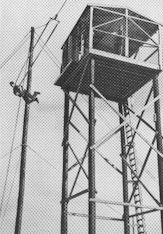
He agreed, and prepared the harness in a loop which was placed around our rumps then placing my left am around his shoulder, and he with his right arm on my shoulder followed by holding the harness with my right hand, and he the harness with his left hand.
In that position we jumped simultaneously. The going down was okay only to a point. We underestimated the power of the cable. At the point of the final downward lunge of two bodies, the cable reacted like a huge recoiled spring which suddenly was released, catapulting both of us up into the air. We separated and scattered by the force of the cable. Jim going one direction, I another direction, and feeling like the man of the Flying trapeze but without the trapeze.
The last thing I remembered was looking up with the ground suddenly and swiftly coming at me. Then a big flash, lots of stars bursting, then blackout. At that split moment my reflexes automatically responded to the sudden impact of the hard ground by rolling my body with the fall thus alleviating any serious injury.
Both of us were momentarily knocked out, but due to our excellent physical condition and training, came to our senses and stood up on our feet.
About the time when all this was happening, the last group of volunteers were still in the mock tower area and apparently saw what happened. I can still visualize their eyes lit up in amazement, wondering what daring nuts these paratroopers were to hit the ground so hard and still be able to get back on their feet.
Little did they know both of us were hurting. Every bone in our bodies ached.
By this time someone on the ground got the medics and transportation to take Jim and me to the Clinic. I hurt so bad and refused to ride and walked instead.
Major Vella examined both of us, gave each an injection of morphine and arranged to send both or us for further observation to the city of Toccoa hospital. At the hospital, after being examined thoroughly, I was told nothing was wrong and could be released the next day after a good rest. However because it rained the following day, I was confined for another day as an added precaution.
While in the hospital I inquired about the status of Jim's injury only to receive vague answers.
After my release from the hospital, I lost contact with Jim. Later, I heard along the grapevine that Jim hurt his back.
Years later, while we were preparing publication of Paratroopers Odyssey in 1985, Clark Archer gave me Jim's Toccoa telephone number. Since then we kept in touch until his mail was returned to me with "No Forwarding Address".
So much for this past daring stunt, and hopefully may dispel any exaggerated assumptions that might have existed these past [fifty-nine] years. Also after this Toccoa episode, there were no more double exits from the Mock Tower at the Parachute School.
In closing, there was an investigation and reprimand for attempting the risky stunt.
John Alicki
Subj: Another tale
Date: 3/9/2002 10:52:01 AM
Eastern Standard Time
From: Jim Mortensen
I'm surprised at the response to the shell-through-the-roof story. There are still a lot of our gang out there who have good memories!
Another time, another story. This happened sometime before Bergstein. I'm certain of that because Bertgstein was the end of the war for me. Except for being pulled out of the hospital in St. Quentin twice (for a few hours each time) for the planned jump over the Rhine, I was away from the 517th. After leaving the hospital I went through the repl-depl and joined the 82nd a few weeks before I flew with the advance party to Berlin.
Back to the story. It was a clear, very, very cold night illuminated by a full moon. We were to meet the tanks at a "T" intersection, then head east with them for an early morning attack. The tanks were to come down the road from the north, turn east and away we would go.
We got there early and stood around in the woods to the south of the intersection and stomped our feet or jogged in hopes of not freezing to death. It was a close call. There was only one form of entertainment. Buzz bombs came over our site in a fairly steady stream as they headed for Liege or the channel ports. They weren't state of the art even then, I suppose, but they impressed us nonetheless. Oh, unmilked cows across the road might count as a second form of entertainment, but not many exhibited much interest in their plight.
The tanks let us know they were coming long before they arrived. The sounds of their tracks on frozen roads carried a long, long way that night. Finally, the first tank approached the intersection. Very slowly, he edged out into the middle and tried to turn left. We then realized that the road was like an ice skating rink and the poor tank driver had zero traction. As he tried to pivot, the tank started to move toward the shoulder of the road. Every time he tried another maneuver he came closer and closer to the ditch. And, finally, slipped over the edge without so much as a whimper.
Tank number two thought he could correct for those mistakes. But in a matter of moments, even at a snail's pace, the second tank suffered a similar fate. Now, the road was blocked. So much for tanks.
So, we went on about our business without, once again, the tank support we had hoped to have. And we disappeared in the night!
I hope some others remember this one, too!
Jim Mortensen
HQ Battery
460th
Date: 3/11/2002 10:51:32 AM Eastern Standard Time
From: Howard Hensleigh
Ben--I think you and I are talking the same time frame. Tom and the other 2nd Bn. men were hit several days earlier. If Tom Cross had been wounded again in the one I remember, I would have made a mental note of it and put in my cryptic notes. At this time the three Bns. were fairly close together rather than being split up and attached separately to every outfit on the front. In my notes I speak of Jackson and that meant H Co. because where Jackson went H Co. went. Here is a quote:
"Next day we went in around Bergeval; got there with H Co. around 0130. Got up at 0400 to get Jackson to stop a counter attack. Went up with I Co. later and got it stopped. We were in the 1st Bn. CP. when there was a direct hit on it. Broken glass, plaster etc. hit all over, but my helmet stopped all that and it bounced off me."
That was several days after the 1 Jan farm house hit that Tom Cross and Dick Seitz remember so well. From what I can deduce it was the 4th or 5th. Possibly some 1st Bn men can fill us in. I know it was an incident to remember, because of the casualties and the fact that the group in the house survived without more than a scratch or two. And, I know you remember the 4th as a pivotal day in your life.
I'm not trying to keep this one alive, but I'm sure we have clarified a number of things. I hope we aren't boring anyone. It wasn't boring at the time.
All the way, Howard Hensleigh
Hi Howard,
Not sure if the house that you
mentioned is the one that I was involved with. I remember leaving Trois Ponts on
Jan 4,1944 going up a hill to Bergerval and was put up in a church (church may
have been in St. Jacques) Sometime shortly after we were awakened because the
Germans were shelling the area. (January 5 ) Ground was frozen, couldn't dig in
and and therefore many of us sought shelter in a sunken driveway. Perfect
protection except for a direct hit. Don't know what happened but have heard
later that a shell hit a building behind us. Seventeen of us were wounded and two
were KIA. I think all were from H company .
Regards, Ben Barrett
Date: 3/11/2002 8:16:46 PM Eastern Standard Time
From: Howard Hensleigh
Should we wear 5 stars or one with our Indian Head for the S. France jump? When I got home there were a few civilians around who wished to impress on us soldiers that they knew about awards and stuff. I got tired of explaining that although I only had one star on my ETO ribbon we were in 5 major battles, so I went back to 5. It saved a lot of chatter.
What did we carry on us when we jumped? Everything, but we had equipment bundles too. I led a machine gun section out. We first tossed out the equipment bundles with machine guns, bazookas and ammunition for both inside. Then we were asked to carry a lot of extra machine gun ammunition. When the opening shock popped my chute open, my musset bag was so heavy it ripped loose and I lost all the extra ammo as well as all my rations etc. This is not news to you troopers, but might help answer the question asked. In short we were loaded so as to be able to survive until resupply became available.
My best to all you Buzzards, the descendants and other well wishers, Howard Hensleigh
Subj: Demolition Inquiry
Date: 3/11/2002
10:11:07 PM Eastern Standard Time
From: Al
Goodman
The answer regarding what the demolition people
carried is correct and coincides with what the Engineers carried. We were
careful to keep the caps well separated from the explosives and among our group
carried enough to prepare a couple of bridges which was our mission on the jump.
My group was with the 3rd Battalion and landed far from the drop zone so never
carried out the assignment. I don't remember what we we ended up doing with the
material but doubt we carried it all the way back to Le Muy. I believe that our
Headquarters Platoon did drop some equipment bundles but don't know if they
retrieved them. My platoon got plenty of demolition experience later at the Nice
airport.
Al Goodman
Date: 3/12/2002 4:14:00 PM Eastern Standard Time
From: Howard Hensleigh
Chris--The 517th came home in August 1945 on the Madawaska Victory [and the Oneida Victory*]. They dropped an A-Bomb the day before we left France and another when we were on the high seas. The War was over by the time we reached New York City. Before we reached sight of land, there was a big rock sticking out of the water; painted on it were the words, "Well Done, Welcome Home". They met us in the harbor with small boats carrying entertainers who put on a show right there in the harbor. The Red Cross was on hand with milk which we drank by the gallons. As we sailed up the Hudson to Camp Shanks on smaller ships, horns and whistles blew and people waved sheets, pillow cases and towels from the apartments along the shore. At Camp Shanks there were Italian POWs in the mess hall serving food like we hadn't seen for a year and one half. Then we hit the trains for home after processing. They gave us 30 days at home before we were to go the west coast and on to Japan. Then telegrams came to stay 15 more days. By then all the west coast stuff was off and we returned to Ft. Bragg or the discharge centers. It was a great way to end the war. Those of us who were headed for Japan beat the ones who went to other units home by several months.
My best, Howard Hensleigh
* Correction: I thought we all came home on the Madawaska Victory. Captain Berry steering that ship, made sure we arrived on time and even in the fog it was full speed ahead. Col. Graves and his staff were on that ship as was 3rd Bn. On page 171 of Paratroopers' Odyssey I find that Clark Archer says we loaded onto both ships you mention, Oneida Victory also. No one should dispute Clark's word. On page 132 of the recent publication we all sent biographies which shows the Madawaska Victory with the Battling Buzzard emblem draped over the side. -- Howard Hensleigh
I don't remember if all the combat team came home on the same ship, but know for certain that the 2nd Battalion came home on Oneida Victory, landing on 22 August, The men of the battalion painted the big canvas 517 banner which was hung over the side of the ship when we docked in New York, The photo of the banner and ship was published in the New York papers. -- Dick Seitz. [Note: See the news clipping with photo on the website Photos page]
The Oneida Victory and the Madawaska Victory were
both involved in transporting the 517th PIR back to the USA. We staged through
Camps Lucky Strike and Phillip Morris starting in August 17, 1945. Page 171 of
Paratrooper's Odyssey refers.
Clark Archer said that he
would forward info taken from the 517th Morning Reports that would officially
settle the varied discussions relative to what Belgian farm house was hit and
when it was hit plus the results therefrom. As has already been mentioned, more
that one farm house was involved in these discussions.
Regards, Tom Cross
Date: 3/16/2002 9:25:17 AM Eastern Standard Time
As concerns Willard Wyatt's story about blasting the armored full colonel. I remember the time and situation very well. It was about the 20th of January when the 2nd battalion while attached to CCA 7th Armored Division. We were attacking Auf der Hardt, a critical objective in the 7th Division to capture St Vith. The 2nd battalion was making the main attack. Prior to this operation, I had been criticized by regiment that I relied too much radio and should use more wire. I put the word out. Lieutenant White, the Commo officer "lay more wire." So Willard and his crew were laying wire, per orders in the attack to capture Auf der Hardt and had just finished when the CCA commander, Colonel Triplett came through in his command tank and tore out all the wire that Willard had jus finished laying. Willard's natural response was to blast the hell out of that big guy sticking his head out of that God damn tank. As I heard the story, Colonel Triplett's reply was "Get the pliers, son, get the pliers." My response would be, "Willard, a big well done to you and your crew."
517th airborne all the way.
Dick
Seitz
Date: 03/04/2002 12:13:48 PM Eastern Standard Time
From: Tom Cross
I am forwarding Dick Seitz's latest message regarding the farmhouse incident described in the above referenced Mail Call. I talked to Dick a few minutes ago and we jointly were able to bring some more facts to light on this subject. Here are our latest recollections:
The date of the incident was January 1.1945. The S-3 of Headquarters 2nd Battalion that was conferring with Dick and Dave Armstrong was 1st Lt. Peche. They were conducting a map reconnaissance of the proposed forward assembly area in preparation of our coming attack in the Trois Pont area. When the enemy round exploded in the rear of the farm house, I was in the act of briefing the advance party prior to moving to the Trois Pont area. This party consisted of company guides from each of our three Rifle Companies and our 2nd Battalion Headquarters Co. The entire party consisted of approximately 12 individuals. We were going to use two jeeps for transportation and they were loaded and ready to go. The enemy round came in and exploded in the midst of our group. Corporal Archie Brown who standing beside me was instantly killed. I remember the timing as I had just passed my map case to him when the shell exploded. The force of the explosion knocked us all down. I was the first person to get up and saw that the others were still on the ground. When we recovered we found that almost the entire group had been wounded with some wounds more serious than others. 1st Lt. Jack West, the 2nd Bn. 81mm Mortar Platoon Leader was one of the group more seriously wounded than the others. Our Battalion Surgeon Capt. Harold Megibow MD had us moved to the basement of the farmhouse where he worked on us and prepared us for medical evacuation that came later in the afternoon. Being wounded was bad enough but we had our two jeeps wounded too. This put Dick Seitz in a bind as he had already received orders to move at a designated time and a new reconnaissance party had to be formed and new transportation found. Fortunately we had a few stolen jeeps on hand that were pressed into service.
We were medically evacuated to a nearby Armored Division's Medical Clearing Station and from that point on I lost contact with those of our group that had been together up to this point. My troubles were not over for when I was evacuated to a nearby Medical Evacuation Hospital for emergency treatment, the ambulance driver became confused and took the wrong route that headed us for the enemy lines. Fortunately a Military Policeman stopped him at the last minute before crossing into danger and we were rerouted to the Evacuation Hospital.
That was a busy day for me because in the course of
my travels I had visited the XVIII Airborne Corps Forward CP. for directions to
the 517 PIR CP and from there to the CP of the 2nd Bn and then on to the medical
evacuation journey. Two memories of this incident remain. I often wondered
whether Dick Seitz missed me more than he did the loss of the 2
jeeps. Fortunately I never asked. Secondly, I was impressed with our medical
personnel and treatment facilities that were located nearby where they could
quickly and effectively service the wounded. Needless to say every New Year's
Day from 1945 to the present brings a moment of self reflection and
thanks.
Would appreciate your adding this to the farmhouse story and passing
this on to Jim Mortensen.
Regards, Tom
Cross
Subj: Colonel Zais..A Great Guy
Date: 3/7/2002 12:20:11 AM Eastern Standard Time
From: Lud
Gibbons
Hi Ben...You asked for my version of the occurrence at
the "posh dance hall" in Paris. I've told this story at a number of reunions and
the Colonel always enjoyed it. Here is what happened:
While at a table in a restaurant in Paris with Cols. Zais, McMahon, Lt. Hensleigh and a WAC Lt. having a Coke or two or more, the WAC Lt. saw a couple of Ranger Lts. about to pass our table and she called out asking them what outfit they were in (she had a friend that was a Ranger). One of the them said "We are Boy Scouts". Col. Zais stood up and told them that they looked like Boy Scouts. With that the talker made some kind of a impertinent remark to the Col. Instinctively I went after him. The fight began but almost immediately someone yelled "MPs!" and that stopped everything dead. A while later as I was coming out of the men's room the two Rangers where waiting and told me to tell those two Cols. that they where waiting for them. When I got back to the table I said, "Those two Rangers are waiting for two of us and I'm one of them". Col Zais jumps up and said, "I am the other one!" When we got outside, the four of us agreed that we should find a quiet, peaceful place, so we could do this without being interrupted. While the four us where walking down the street looking for a site, which took a little time, the Lt. next to me kept telling me and telling me, what a tough, rugged, mean guy the Col. was up against. We found a dark quiet alley. After going up the alley a little way my guy and I stopped while the Col and his friend kept on going. I took my guy down (I wrestled in H.S.) and was kind of sitting on him, giving him time to realize that the fight was over and he wasn't going to get up until I was ready to let him up. While sitting on him I heard foot steps running down the alley, coming from the direction the Col. had gone. I remember thinking "Boy, am I in big trouble now!!!" It was Colonel Zais!! In a short time the Ranger Lt. shows up. He tells how as soon as they faced off and put their hands up the Col. knocked him down, how as soon as he got up, the Col. knocked him down again, this happened three or four times before he got the message, "Maybe I would be better off if I didn't get up." Now that that was over, we decided to go back to the restaurant and have a drink together. When we got out to the street where there was some light and you could see that the Ranger Lt. had gotten up at least once too often. He was bloody and we all agreed it would be best if they didn't go back with us.
Lud Gibbons
(See page 371 in the paperback copy of Gerald Astor's "Battling Buzzards".)
Date: 3/16/2002 4:12:26 PM Eastern Standard Time
From: Russ Miller, 3rd Platoon B Company
My memory is rather dim on WWII days, but will try to contribute my recollection of an event or two anyway. Further, over the years since the war, I've been able to rely heavily on my very good friend, Howard Hensleigh, whose memory continues to astonish me. By the way, Howard and I date back to the U. of Iowa, OCS, jump school at the same time and reported into the 517th together on the same night - then on through the war, Howard in the 3rd Bn and I in the 1st Bn, how about that?
Have a question about the enemy howitzer which used to fire flat trajectory shells into our platoon position from its location inside the fortress on Monte Grosso mountain on the Italian border. The huge, concrete reinforced doors would open slowly, the howitzer would roll out on tracks of some sort, blast away at us, pull back inside the mountain and the doors would close. We lost our platoon medic to that weapon. Question: did we ever try counterbattery fire on that gun, or any other tactic to silence it? --- We named that gun "Jake the Barber" as I recall. He fired so often in our direction that almost all the trees in our area had their upper branches sheared off, complicating our night patrol missions down through the draw because just a little wind would cause these branches to make noise and we were spooked every few yards assuming what we were hearing was an enemy patrol approaching us from the other direction. -- Does anyone else recall our taking the Monte Gross terrain and getting inside the fortress?. Some of our 3rd platoon were inside somewhat briefly - it was likely a permanent installation on the Italian side of the Italian French border: It had all sorts of rooms carved out of the mountain and could maintain troops, mess facilities, ammo storage and who knows what else on a continuing basis.
We admired Lt. "Whitey" Hillsdale, Exec Officer B Company, a really good tactician and good with the troops. Our platoon was once assigned a mission to locate and destroy four French howitzers positioned along a ridge line in southern France. A couple of demolition specialists who were to blow the guns if we could locate them accompanied the platoon. Before we departed on mission "Whitey" gave me a card oriented to the side of the mountain we were to climb where the guns were located. The card showed about 6 sectors of terrain which were numbered 1 through 6. If we encountered problems with the enemy, we could call for 4.2 mortar/artillery fire which would land on the particular area we wanted hit. As we moved in a line of skirmishers toward the upper levels of the mountain, we saw about a dozen German soldier, clearly silhouetted walking right along the skyline parallel to our platoon. They saw us about the same time we saw them, began firing and throwing their potato masher grenades which diabolically rolled down the hill toward us before detonating. Using "Whitey's" numbered card, we called for fire and began to withdraw from that position. Seemed to me less than a minute later, if that long, our barrage came rolling in and we heard nothing more from those Germans.
Russ Miller
Date: 3/15/2002 7:18:01 PM Eastern Standard Time
Subject: Ray's mail regarding Hal Jeffcoat
I remember him and knew him well during his tenure with F Co. Also after the war . I don't know about Whitehead, but he sure wore out my catching hand while we were in the volcano crater outside of Rome. My hand still hurts when I think about it. In France, just outside of Luceram, Jeff and I were guarding about 5 prisoners when the Germans laid down a barrage of 88s. While trying to guard these guys, and bravely take cover without their knowing our fear, it was a real rodeo. After that I saw Jeff no more. After the war, while in law school in Tennessee, I noticed his name a a player of the Nashville farm club for the Chicago Cubs. That year he led the Southern Association in batting. After school, I returned to Texas, move to San Antonio. Lo and behold the Cubs play an exhibition game here with the old St. Louis Browns. Jeffcoat had been brought up to the Cubs and played center field. I called him and for the next couple of years when they played their exhibitions we met. Plenty of beer after the games. I still have a baseball autographed by all those guys Yes, Ray is right: Jeff started out as an outfielder and wound up a pitcher. He was one of the fastest runners I have ever seen and had a terrific arm. His batting in the majors left a little to be desired, consequently his change form the outfield to pitching. I do not know where he was from, but for some reason I thought he was from Mass. Best to all . I'll not forget those days.
Randolph Coleman, F Co.
Entry of Mar 19, 2002 at 17:13 [EST]
From:
Gene Brissey , Company E
Subject: What We Carried
I have enjoyed
reading recent mails as well as all the others. Howard provides great items.
Wish I had known that man. Of course all the others who contribute do very much
to make Mail Call a pleasant experience. Robert Cooper and others
discussing what we carried when we jumped has been interesting. I think Flora
Newby, started this line of thought, so this is for, Flora. I remember a few
items carried by most troopers, starting with a canteen of water, a gas mask, an
entrenching tool (shovel) , the main parachute on the back, a musset bag with a
couple hand grenades, food for two or three days, personal items and, God, only
knows what else. This bag was placed over the front and a weapon strapped over
it. Ammo was stuck somewhere. Then the reserve chute strapped across the chest
area. As for me, as demolition man for our company I had 30 pounds of nitro
starch (explosive) strapped to the upper part of one leg and 30 pounds of TNT
strapped to the other. Blasting caps were placed in an upper pocket. Across my
front was a Tommy Gun. With equipment and my not so large body I weighed about
300 pounds. One of the guys took a picture of me and claimed that it weighed
seven ounces. I struggled to the plane but needed two men to drag me up the four
or five steps into the plane. Later, getting to the door and jumping was
extremely difficult. A hard landing in total darkness hurt both legs but this
only slowed me down a bit. I used some of the explosives to remove a German
roadblock and carried the rest for two or three days and then discarded much of
it for which I was strongly admonished by a company officer. Didn't need the
darn stuff again. Gene Brissey
Entry of Mar 23, 2002 at 10:01 [EST]
From:
Bob Cooper , D Co.
Subject: Equipment
A couple of items Gene
Brissey omitted a length of pre tested Safety Fuse a crimping tool and some
wooden matches in a water proof container. I also had a nickel plated steel
mirror in a leather case which I carried in my left breast pocket which I still
have. If my memory still serves me 3rd platoon D. CO. had a mission to move out
to a village or town the name of which I cannot
remember occupy some high ground and wait for B 25 bombers to bomb at 7:00 or
7:30 AM and then move in on a German OCS School. We practiced for that mission
for weeks. Then as we all know we were 5 or 6 miles off our drop zone. I can
remember hearing the bombers but we had no chance to get there. Our drop zone
was supposed to have irrigation ditches running parallel to the azimuth we were
to follow after securing my gear I took a reading on my compass. With all the
fog you could not see your hand before your face. I could hear water running so
I thought I was all right took two steps and fell into one of the ditches
knocking my helmet off I grabbed it put it back on my head water and all. We
managed to all assemble in the corner of the zone we were in. As I remember
quite a few of us were mad we couldn't reach our objective. Hey I got kind of
windy tonight while most all of you are sleeping. If I am wrong I know some of
you Historians out there will set me straight. Still Air Borne all the way
Bob Cooper
Entry of Mar 23, 2002 at 15:41 [EST]
From:
Howard Hensleigh , Hq Co, 3rd Btn
Subject: 25 Mile March
In
looking through the pictures, I saw a number of Chuck Glass of G Company.
Now I am going to relate the story of how G Co. broke the Army record on making
the 25 mile march with full field equipment. I wasn't there. It occurred just
before Russ Miller and I reported in to Major Zais in November
1943. The story was fresh on everyone's mind at that time. As mentioned by
others and as I believe as related in the Odyssey, Col. Walsh selected
different companies to break the Army records. It fell to G Company to break the
25 mile march record. Every man present for duty had to hit the road. Chuck
Glass arrived about 0400 hours on the day appointed fresh from a big time on
furlough. He was present for duty and shouldered his field equipment, which
included the company's light machine guns and 60 mortars. Hour after hour the
Company ground out the march. Chuck in the last mile or two passed out. This was
just another small problem to be solved. Along with the machine guns and
mortars, the Company shouldered Glass and carried him across the finish line to
break the record by several hours. According to the troopers who made the march,
the whole Company was about to expire during the last mile. Then someone started
to sing -- "Airborne we fly the skies, paratroopers do or die............."
Hooper loved that song so it probably was the CO who started it.
Undoubtedly Lt. Steele joined in and he could raise the dead. This perked
up the unit and they crossed the finish line with heads high along with Glass
and the crew served weapons. I am sure Dallas Long and others can add to
this one, or correct me if I am off base. Before I leave Lt. Steele, he
almost got shot in the early pre-dawn hours on Tennessee maneuvers. We had made
another forced March of at least 25 miles without food or water. We bedded down,
but were roused from our pup tents half dead to move out. Steel chose this
occasion to sing "Oh, What A Beautiful Morning"! You won't believe it, but I
loved the Army. Howard Hensleigh
Entry of Mar 24, 2002 at 15:12 [EST]
From:
Dick Hammel , Hq2 & E
Subject: Memories
All this talk about
memories makes me sad. There is so much I can't remember. I remember breaking my
leg in jump school and making my last jump in the last of January. Oh yes, I was
one of the early members of Co E in Toccoa. My 6th jump was into Southern
France. I remember the wet and cold of Tennessee. Eating C rations in a ditch in
Italy beside a dead German artillery horse. The tall white officers with the
short Japanese men of the 442 Inf Regt relieving us in Italy. Jump into the fog
in southern France. Loosening the baseplate of my 60 mortar during a river
crossing. Transferring to Hq 2 and trying to satisfy the Sgt Major and Operations
Sgt with exactness in spelling etc. in typing after action reports. The cold and
snow of the bulge. Late Christmas dinner with so much food for the few of us. I
guess there is a lot that I don't want to remember. Dick
Hammel.
Entry of Mar 27, 2002 at 09:15 [EST]
From:
Ray Hess , F. Co.
Subject: Bergstein
Good Morning Ben: I have
observed that there are not many messages to you concerning Bergstein. The first
night at Bergstein is like a dream that I can still picture in my mind. Three
Battalions crossing one another, in pitch black darkness and pouring rain, mud
up to our ankles, then the Kraut flares going up, the burp guns ending the
silence and then someone yelling, Go Back , and
the 517th retreating and looking like a herd of sheep crossing Hoover Dam. "F"
Co., leading the 2nd Battalion had about a dozen men caught behind the lines and
taken prisoners. When we finally were replaced, I think , if my memory is
correct, had either 13 or 16 men left, no officers, an N.C.O. as Company
Commander. Anybody else have any comments to share on Bergstein? Best Regards to
all R. Hess
Entry of Mar 28, 2002 at 14:59 [EST]
From:
Gene Brissey , F. Company
Subject: Bergstein
Subj: Ref. Mail
Call 263, Ray Hess Note Date: 3/28/2002 1:42:31 PM Eastern Standard Time From:
Genedie77 To: Ben517 Hi Ben, Ray and all Others. Ray, I remember so well the
horrible times you wrote about our misery in and around Bergstein. As I recall
we struggled through the mud into Bergstein, under heavy fire. A German flare
would light the total darkness, we would freeze in place until the flares burned
out and then continue our entry into and beyond what appeared to have been a
town. We fell into ditches over dead animals and humans, no doubt. It was so
dark we could see little except flares and gun fire. I believe this was Feb. 6,
'45. We were unable to obtain our objective. We few moved back into the rubble
of Bergstein. I believe an officer from F Company named Giuchici and some
men were caught behind the German lines. We thought they were gone but somehow
they escaped. On the 7th we hovered in the rubble of Bergstein and tried to dry
our selves. I burned the top of one of my boots, which I still have. Some of us
took shelter in a structure which had only three sides and no roof. A piece of
shrapnel came into the place and bounced off all three walls. Worse things
happened that day but the worst was yet to come. About 9:00 that night we tried
once again to slither through one of the largest mine fields, ever, toward the
Kall River. As we crawled through the woods the Germans threw grenades at us and
finally we had to move back to a cleared hill near the town. We had very few men
left. The only officer that I remember in E Company was Capt. Newberry.
Another Sgt. and I were leading the third platoon which consisted of very few
men. Two men by my side were wounded by mortar fire and my good friend, Sgt.
Roger Bender was killed before orders came to move back to Bergstein. As
we moved back under heavy fire our mortar man threw down our fully assembled
60MM mortar and ran for his life, he made it. I picked up the weapon and headed
for town. I didn't make it on my own. As I approached a large building being
used as the aid station I was hit by shrapnel which tore through every piece of
clothing except my left glove, my helmet and my burned boots. Two men came and
dragged me to the aid station where Capt. Newberry gave me a cigarette and a
medic gave me a shot of morphine. I responded by vomiting on the captains boots.
Soon evacuated and never saw the outfit again. I returned to Bergstein in 1995
which had been rebuilt into a very nice little town. Gene
Brissey
Entry of Mar 28, 2002 at 19:14 [EST]
From:
Howard Hensleigh , Hq. 3
Subject: Battle of the Bulge
Note to H.
Ramsey White, III re: James L. Kitchin I have written about this before,
but will give it a shot because of your message about your grandfather. The
Third Battalion attacked south of Stavelot with 13 phase lines to cross at
certain times, with the 75th and 30th divisions on our right and left, to cross
the phase lines at the same time. We took the high, tougher to take, ground and
reached the 13th phase line on time. We were to make contact then with the
outfits on the right and left. A squad from G
Company and a few of my S-2 men were selected for this mission. Your grandfather
headed the G Company men. We started out in the morning and went across our
entire front in snow knee to hip deep, first to the right and then to the left.
We ran into German defensive positions, but no U. S. troops, on both sides. This
slowed us up; it was an intelligence and contact patrol, not a combat patrol.
The other outfits didn't make the effort we had made with resulting casualties.
We ended up on the left of our front at midnight, about two miles from our
nearest troops, some G Company men. The password (sign and counter sign) changed
at midnight and we didn't have it. We had the choice of struggling back through
the deep snow or taking a road where the snow was packed from German traffic.
Since some of the men were exhausted I was inclined to take a chance on the
road, but that was not the "book solution". So, for the first time, I took a
vote. It was unanimous –- the road. We moved out at a fast clip and after the
two mile hike heard the "sign" loud and clear. The battalion had suffered
several casualties resulting from our own men not knowing the counter-sign. Also
in the Bulge there were many German troops who spoke perfect English. To solve
this predicament, your grandfather in his deep southern accent bellowed, "This
is Sergeant Kitchin and we're commin' on in!" Everyone in G Company knew that
there was only one in the world who talked like that and that he was one of us.
He saved the day and we bedded down in the snow for the night. Many years later
at a 517th reunion, your grandfather collared me and told me that when we ran
into the Germans on both sides, he had asked me what we were doing out there and
that I had replied that we were just out there looking around. Apparently I
didn't want to state before the men that the other troops, who were supposed to
be protecting our flanks, hadn't fulfilled their missions as we had, and that we
we were sticking out there like a sore thumb. Then he said, "Now, what were we
doing out there?" I told him the story substantially as it appears above.
Fortunately we are no longer encumbered with real or perceived notions of
propriety and can say it now as it was. Your grandfather was a great guy.
Howard Hensleigh
Entry of Mar 29, 2002 at 20:05 [EST]
From:
Joe D. Miller ,
Subject: Letter to Chaplain Brown - Feb 1986
February 10 1986
Rev. Charles Lynn Brown
Blowing Rock, NC
Dear Rev. Brown:
Let me introduce myself as the first soldier you met after landing in southern France. That experience was one which I shall never forget and maybe you will enjoy hearing my version of that event.
Reading the recently published history of the 517th Parachute Combat Team entitled, "Paratroopers' Odyssey," prompted me to do so. On page 49, paragraph 3, the following comment is made:
"A mile and half south of Le Muy, Regimental S-3 Major Forest Paxton assembled his stick and waited for daylight. He then moved north, picking up Alicki, some of the demo platoon, and a collection of high-ranking talent including Regimental Surgeon Major Vella, Chaplain Brown, and Major Kinzer of the artillery. Moving west toward La Motte, Paxton gathered up another 75 men from F Company, the 460th, and the Engineers. At La Motte contact was made with Company E. The energetic Paxton then went on to set up the Regimental CP at Ste. Roseline. When Colonel Graves arrived at 1300 Paxton was issuing orders for the removal of anti-airborne obstacles from the Drop Zone."
This statement plus the map on page 42 helped me locate our exact drop zone. If I am correct, you and I landed a few hundred yards north of Highway N7 and either in or on the banks of the Nartuby River. I had touched down safely on the unseen edge of the river bank and, to my surprise, tumbled backwards over the cliff to the edge of the water. In the process, I sustained a fractured right foot and was left hanging by a chute that was caught in the tree tops above the bank.
Although I knew I was not badly hurt, my dangling position made it most difficult for me to get out of the harness and ready for battle. During those awful seconds which seemed like hours, I realized someone was wading the stream and approach in my position. A moment of panic occurred but then I decided to remain very silent with the only weapon I could reach, my jump knife, firmly held in my right hand. It was my intention to defend myself with the knife if this person seemed to be the enemy. Had you moved six inches closer before giving the password, I am quite certain the worst would have happened.
In all the darkness around the edge of the stream, no one could see that You did not carry arms or that you had on a friendly shoulder patch. This I realized as you were helping me climb to the top of the river bank. Shortly afterwards, I realized you were Chaplain Brown and I was embarrassed because I had used some very salty language due to the pain in my foot.
You may recall that as we were moving along the river toward the highway, we were suddenly halted by a booming voice that turned out to belong to a British Sergeant Major, who had already assembled his troops and was preparing to do battle in Le Muy, which was their assignment. I was impressed with the fact that he had his act together so quickly and that we were still in limbo.
All of this occurred while it was still too dark to really see what we were doing. Nevertheless. the two of us moved on to the highway where you scared a Frenchman on a bike half to death by halting him as he approached the bridge. Seems to me that he was suspended in mid air for several seconds while his bike continued toward town.
About that time, we met some others from the 517th and that was the last time I recall seeing you. I was able to hobble several miles that day; but once I stopped and removed my boot, walking was impossible.
The rest of the story nee d not be told and I had only intended to recount an incident of some significance to two strangers who met on a dark, foggy, early morning August 15, 1944.
It would be interesting to hear your accounting of these events. I am certain our stories will differ, but to what extent would be interesting to learn.
Sincerely, Joe D. Miller
Entry of Mar 29, 2002 at 23:21 [EST]
From:
Charles Lynn Brown , 517th Chaplain
Subject: Letter to Joe Miller - May,
1986
May 30, 1986
Mr. Joe Miller
Frankfort, KY
Dear Joe:
Your letter brought back a clear memory -- half frightening, half-humorous. I remember landing, over water as we were told but really over land -- and the exact episode you describe.
The poor French farmer was on his way from his village to his farm outside the town. We were in the ditch by the road. I stopped (!) him and asked where we were. I also asked if there were Germans still in the village. He said "yes" -- squawking like a stuck-pig. I told him to "shut-up" (Tais-toi -- which is French for telling a barking dog to hush.) I have regretted my un-Chaplain-like language. I was afraid of German patrols in the area. When he got up, he started back for his village and I told him to go to his fields but not return "this way".
I am glad you made it back safely. What you may not know is that when I dropped I thought I had sprained my ankle. When we got together with Maj. Vella, he shipped me back to Naples (hospital) with a broken ankle. It was only a small splintered bone. After two weeks in the Naples Hospital -- complete boredom -- I hitched a ride on a "blood plane" to rejoin the 517th... using a cane. Col. Graves merely said: "You have been reported AWOL for the past two weeks". That was the end of that.
I enjoyed the history of the 517th. But it was primarily a "military history". It did not include the personal bits which you have helped supply.
All my thanks! If you are ever this way, please come and see me. Meanwhile, all my best!
Charles Lynn Brown
Entry of Apr 8, 2002 at 14:42 [EST]
From:
Gene Brissey , E Co.
Subject: Premonitions
Subj: Combat Related
Premonitions Date: 4/8/2002 2:23:58 PM Eastern Daylight Time From: Genedie77 To:
Ben517 Mail Call readers may or may not believe in premonitions. I'm not sure
that I do. But, last night sleep was slow in coming and I started thinking of
three close friends and platoon mates who may have had premonitions of things to
come. I would like to share these stories with you and learn if there are any
similar experiences. The following combat friends may have had premonitions.
Charles Lemen, two other friends and I sat talking as we waited to board
the planes to depart Rome for the jump in Southern France. Charles, told us that
statistics indicate that one of the four of us would be killed in or soon after
the jump. During the first combat after the jump, near Les Arcs, Charles took a
direct hit from a tank. He was laid to rest in the cemetery at Draguignan. He
remains there to this day. I have visited his grave site on two occasions.
C.B. Jones, was the first would be paratrooper that I met at Camp Toccoa.
I was alone in the barracks when he and others returned from the firing range.
He was loud and pleased that he had made the highest score of the group. For
whatever reason he came to me and told me of his success with the M-1 and
proceeded to show me how to take it apart and put it back together. We became
close friends. C.B. liked this weapon and had another item which was much of his
life, a 35 mm camera. He handled his camera and the M-1 with great care. He
never allowed the camera out of his sight and took many pictures of the troops
and carried it with him in Italy and the 93 days or so in France. After we
returned from the Alps to our tent city near Nice, he for some reason requested
that I take control of his camera and send it to his family if he did not
survive the war. I carried the camera in my barracks bag from that time forward.
During the first battle, for E Company, in the battle of the bulge, C.B. was hit
during the effort to liberate Mont de Fosse on Jan. 3rd "45. He begged to be
allowed to live but died several hours later in an aid station near Trois Ponts.
To further the hurt I lost his camera and all things in my barracks bag when I
was wounded on Feb. 8th in Bergstein , Germany. C.B. was returned to Landis,
N.C. where he now rests. Roger Bender , and I became best friends when he
and I teamed up to pack our parachutes for our first five jumps. We endured
Italy, France and Belgium through the Liberation of St. Vith. We were then taken
to Stavelot, Belgium for a four day rest in a large brick and stone building.
While there Roger requested that I go see his wife and extended family should he
not make it. In the battle around Bergstein he was killed a few minutes before I
was wounded. From a hospital in England I was returned to a hospital at Camp
Patrick Henry, Indiana, near his home in Bloomington, Ind. I was able to visit
the family. They asked if he suffered in death. No. But I could have said that
he suffered during many close encounters with death along the way. Roger, was
returned and buried near his home in Bloomington. These men may have had some
view of the future. Are there premonitions?
Entry of Apr 17, 2002 at 14:30 [EST]
From:
Ed Flannery , G Co.
Subject: Jim Kitchin
Subj:
James L Kitchin Date: 4/11/2002 1:21:58 AM Eastern Daylight Time From:
edflannery@earthlink.net To: ben517@aol.com Sent from the Internet (Details)
Jim Kitchin's name came up recently in Mail Call. It reminded me of a
quiet Sunday afternoon in Joigny. The barracks were empty and very quiet. I
decided to take a walk. The part of Joigny on the opposite side of the Yonne
river was unknown to me. So I crossed over the arched bridge and turned left on
the road parallel to the river. Hadn't gone very far when I looked ahead and saw
a pair of legs, prone, toes up, sporting a shiny pair of jump boots, protruding
beyond some open garage doors. This sight heightened my anxiety considerably so
I rushed on to see what was happening. As I rounded the open doors I witnessed a
sight that would make any mountain lad homesick. There in front of me was a full
size whiskey still in operation. The smiling Frenchman was processing some mash
from rutabagas to make some eau de vie. The still was cranking, the frenchman
smiling, and Jim Kitchin lying flat on his back, mouth wide open,
catching the output. I asked him what the hell he was doing. He said he had
found a good place to get a drink. With my background I knew what the effect
would be, so I dragged him out of there and headed back across the river with
Jim in tow. I knew I had to get him to bed soon. After thwarting several
attempts to go swimming in the Yonne off the bridge I was able to get him up to
the third floor of the barracks where he obediently laid down on his slat bunk.
I knew he was being obedient for a reason so I sat down in the doorway and
waited. Soon, here he came sneaking along a row of bunks intending to go back
out. This sneaking event happened twice before the full effect of the eau de vie
took place. I left him snoring loudly. He slept till Monday morning. Ed
Flannery Sebastian, Fl.
Entry of May 18, 2002 at 16:04 [EST]
From:
Jesse Darden , Hq. 460
Subject:
This is a story that happened in
ITALY (44), the 517th was on a move, walking of course along with the 460th, as
we moved along Fred Brown and I came by what we thought was a bar and
outside sat a small motor cycle. Well guess what? Fred an I decided to not walk
any father so we hopped on and took off with the owner shouting at us. Guess
what happened when we got to where we were going? Captain Weinstein took
charge of the bike for mail runs. I don’t know if the Italian ever got his bike
back. More stories later. Jesse Darden
Entry of May 26, 2002 at 21:02 [EST]
From:
Russell Miller , B Company
Subject:
Memorial Day prompts me
to think back on 3rd Platoon, B Company days in the vicinity of Petit Thiers,
Belgium and in the general area leading toward St. Vith - best I can recall
about the geography. We'd been in the attack for a number of hours, supported by
tanks which halted with they reached their objective and we, the good old
infantry went on ahead without them. When our battalion halted for the night,
3rd Platoon was assigned on the perimeter and with great good luck in this
wintry weather, located and occupied a house from which the Germans had departed
apparently only a short time ahead of us. There was a good wood fire burning in
the fireplace and pots of food boiling over the fire which the Germans were
obviously preparing for their evening meal. Too bad they never got to eat it.
Does anyone remember Lt. Bob Engelien? He was in B company for a period
of time. Brave guy, good man. He was wounded several times and spent a lot of
time away in hospitals and recuperating. Went to Korea where he lost a leg to an
enemy anti-tank gun. After medical discharge, he became the first, or one of the
first, persons to ski on one leg (and on only one ski, of course) and later
taught many others to build confidence by doing the same. Have not heard from
anyone yet about "Jake the Barber" on the French-Italian border in the general
area of Sospel, France -- the enemy howitzer which, after the huge reinforced
concrete door would crank open, would roll out on tracks from the fort inside
the mountain (Monte Grosso?) and blast away at us Russ Miller
From: Gene Brissey , F Company
Subject: What did you do in the war Daddy?
Subj: Memorial Day 2002 I want to ramble on a bit about our veterans and their families. Many times I have read letters from family members who say that their husband, father, grandfather or whomever don't, won't or whatever, talk about their experiences during their military service. Why? Why? Why? Are we afraid that we might cry or something? I've been there and it feels good sometimes. If there's anyone who reads this, refuses or hesitates to talk about their military time I say go for it. You don't have to go into gory details. Sure, there are probably more bad times than good times but we can handle that. Our wives, children, grandchildren and others are interested in what we did. Could it be that no one seemed interested years ago. If so they apparently do now considering all the mail to Mail Call asking for information about their whomever. The latest being Lori asking for info on her father, Orville Stubbs. I knew him from Toccoa onward, but only he can relay what he did during any time period. I know that he was with the outfit after bloody Bergstein because I have a picture of 40 E Company men who were able to be with the company after Feb. 8, 1945 after departing Bergstein. As for me I was unable to get through Feb. 8th. I missed by three or four minutes. I probably have the "battle rattles" as badly as the average veteran and I didn't talk much about my experiences probably because I thought people weren't interested. After I was married and fathered three children I still didn't talk about it because I wasn't asked. Many years ago I decided to write my story for my children. I found it was rather easy to do so without writing too much about death and those who were wounded around me. I called the story, A DEVIL IN BAGGY PANTS or What Did You Do in the War Daddy? The primary part started at Camp Toccoa and ended in Bergstein. The kids and now the grandkids think it's a great thing. One paragraph that still nearly brings tears to my eyes concerns my writing about my good friend Paul Craig. Soon after we went to Europe his wife had a baby. Paul never saw it. He was killed in Trois Ponts. I wrote that the child probably asked her mother, what did daddy do in the war mommy? This is becoming too long so, I'll just urge all who have not done so already, talk about it or write about it. Those who you will leave behind want to know what you did in the war daddy. While we are at it lets not forget those family members and friends who we left behind. Some may have had a worse time than some of us. Gene Brissey E Company
From: Gene Brissey , E Company
Subject: Fifty -eight years later
On May 31, 1944, we landed in Naples and started a long journey through
Italy, France, Belgium and Germany. Of course most, if not all, the guys know
that. I just wanted to say something to help fill your mail call pages. Marching
through Naples that first day started quite a memory bank. First I was shocked
to see men urinating in urinals built into to walls along the sidewalks, the
destruction and poverty were overwhelming. Women begging every day and night for
many things in order to feed their families. A couple days later we were in that
crater waiting with great anticipation and wonder about getting into combat.
Some of the less intelligence ones, including me of course, sneaked out trying
to find some real combat. The first thing that reminds me of combat, while in
Naples, was guard duty in town. Planes were flying over and search lights were
roaming the sky. I was taking this in with great interest when an electric train
blew it's shrill whistle. I hit the pavement so hard and fast, my chest hurt for
days. I did learn from this because I could hit the dirt as quickly as anyone
when we finally got into the real thing. I heard many times that if you could
hear the shells coming in there was little danger of getting hit. I always
believed it especially on Feb. 8, '45. When I heard dozens screaming overhead,
then one or more came in which I did not hear. The shrapnel got me, but this
time I did not land on clean pavement, just mud and blood. I know this won't
excite the heck out of many people but a mail from Craig Wiseman about
his father and Tom McAvoy's reply to him got me to start thinking about
dates and stuff. So, enough of this. Gene Brissey
From: Irma Targnion , Belgium friend
Subject: 1944 Battle of The
Bulge
----------------------- 1944 - september I am 4 years old. My
father and my God-Father Louis are plucking the apples. My God-father Louis is
my father's brother, his is living with us because my grand-parents died before
the war. To-day, my God-father is very happy, very soon he will get marry with
his fiancée Louise and he is very happy because many young men are everywhere in
our village. They are all so nice and beautiful and Louis calls them "
américains". He tells me : "come with me in this field behind the farm-house".
All around this field, there are many, many young soldiers, smiling to me, they
call me "baby" (I am not a baby) Louis is bringing a big basket full with apples
and I am giving apples to the soldiers. They give me a lot of little boxes and
my God-father is telling me : "say Thank you". When the basket is empty of
apples, it is full of chocolates, chewing-gum, sugar and many good things.... A
few months later, nobody is smiling in the farm-house, nobody is laughing and my
mother is crying. All the men are having a reunion with the oldest one. My
mother tells us that all the men will leave from the Ardennes to the center of
Belgium and that we shall leave our home to go to Auntie Mary's in the basement,
this cellar is vaulted. So, my mother, my brothers René and Roger (6 and 2) and
me cross the road to join auntie Mary, Auntie Pauline and our cousin Catherine.
They are bringing a lot of things in the cellar to eat and to drink and to
sleep. Auntie Pauline is a very clean and proud old Lady, she is covering with a
bed sheet a heap of potatoes, it is her corner. We could not go in her corner,
she whishes to keep it clean. Go away, she says. My brothers and me are restless
and my mother says : be quiet, silence... Somebody is knocking at the door.
(just after a very big noise) The neighbours are coming to stay with us. A bomb
destroyed their house, nobody is hurt. Hélène is looking thru the little window
to see the soldiers' boots, she says : Germans...she is afraid and we begin to
pray and pray and pray, my mother is crying, my little brother is sick. Boum,
boum on the door, a German soldier is roaring, my mother is livid. Some German
soldiers are coming, they are carrying a wounded man, he seems to be very ill.
They say to Auntie Pauline :"move, move..." and they lay down the man in her
corner. He was full of blood, mud and very dirty. A dirty man in the so clean
corner of Auntie Pauline ! . René, Roger and me, the 3 children in the basement,
we are laughing, laughing, uncontrollably. Our mother is white, livid and she
mutters : " be quiet, shut up.." ...(to follow)
From: Howard Hensleigh , 3rd Bn. 517th
Subject: Mel Zais
Mel Zais made a big splash wherever he was. Even as a major he
had the characteristics of a four star general which he achieved before hanging
up his jump boots. I always had the most respect for him during my time in the
outfit and through later years. This episode is not meant to be disrespectful,
nevertheless it is hilarious. But, no one laughed at the time. . We were about
to make a forced march of over fifty miles without food or water during
Tennessee maneuvers. No one told us this at the outset, but we learned it step
by step through those Tennessee hills and vales. As I recall we were the red
troops that should have been captured by Thursday of the maneuver week so the
umpires (like Johnnie Neiler and Al Goodman) could enjoy the week
end while we enjoyed our pup tents in the mud. The only hitch was that Lou
Walsh wasn’t about to let his regiment be captured. We crossed swollen
streams on rickety foot bridges that weren’t even on the map and went day an d
night, which wasn’t much worse than the pup tents in the mud. They never did
capture us because the blue troops quit and Lou won the war. At the beginning of
this march, several tanks blocked the road the 3rd Bn. was to take. Mel
cleared the way with a few choice words to the tankers that might have started a
riot in Phoenix City. Then with the hand signal to move forward, he shouted,
"Let’s get this show on the road!". In Mel’s first step his boot hit a
protruding tree root. He went spread eagle into a small lake of mud and water
thoroughly stirred up by the tanks. He made a big splash. Like the true leader
he was, he was out of the muck in seconds. Without a hitch, he led us on into
the night.
From: Gene Brissey , E Co. 517
Subject: Bergstein
Our
trudging through the mud into Bergstein was quite an ordeal. Those flares were a
new wrinkle of warfare as far as I was concerned. But things only got worse as
we went through the mine field into the forest trying to reach the German
positions. We were in a different spot than Lud, I suppose but it was
hell. We were told not to fire as we crawled through the trees and brush. The
Germans were firing and throwing potato mashers at us all the way. I saw one
German but did not fire. We struggled for a long time but someone finally
decided that we could not get through so we moved back to a hill top without
trees and started digging in. A flare or two went up which told us that we were
going to get it. We did. Two men beside me were wounded and at least one was
killed, my good friend, Roger Bender. He and I were the leaders of the
platoon. We had no platoon officers. We were beyond doing any good and finally
received orders to withdraw. Withdraw, no way just retreat. This is the only
time that I clearly remember that we could not accomplish our mission. We had
only about a third of a platoon of men by this time. I assured that all who
could move, do so and then I split for Bergstein. Got close to the aid station
and was blasted by shrapnel. Two men came and dragged me to the aid station
where I received a shot of morphine and Capt. Newberry gave me a
cigarette. I responded by vomiting on him or around him. The war was over for me
and as I hear the 517th never returned to combat. Bergstein area was as bad as
it could get, in my opinion. I returned there in 1995 and there was a neat
little town but I only saw one citizen. Gene
Brissey
From: Burton Stadler , HQ Co., 2nd Battalion
Subject: Stories
from my grandfather
I have attached a photo of a 517th trooper, my
grandfather Burton Stadler. I had mentioned him in the mail call months
ago, but have not received any responses from other veterans who may have known
him during the war. I thought I would send in this photo and some background
info to give it another try.
From: General Richard Seitz , 2nd battalion
Subject: Battle of
The Bulge
Ben, recently I came across a book that has many fine remarks
about the 2nd Battalion while attached to the 7th Armored Division in
operations to recapture St Vith. The name of the book is A Colonel In An Armored
Division, by Triplett Missour Press. One of the many favorable comments
in the book praised the 517th troops. Quote( Triplett speaking) From my
point of view I was impressed by the courage and capable, uncomplaining
performance
of these men of the of the 517th parachute regiment. The spirit of the battalion
was well described by a tank commander I talked to the day after their relief. I
sure like the them parachutist work. WE were outposting this crossroads, see,
and this guy comes up to me and said, say chum, I ve got me a German bazooka
see. Now if you hear a Kraut tank coming up that road tonight don't you shoot
it, you call me, I'm digging in just this side of that clump of bushes. And make
sure you don't call that sonofabitch on the other side, he's got him five
already and I ain't got but one. Yes, I sure like the way them parachutes work.
end of quote. This indicates the high respect the tankers of the 7th Armored had
for the 517th
From: Jesse Darden , Hq 460
Subject: Lucky move
Some
where in the mountains of Italy we needed to have a radio relay station on a
firing mission. so Sgt. Messinger took Layton Mabrey and I to the
foot of this high mountain pointed up and said see that high peak set up there,
well on the way up we came across a family having lunch and were invited to eat
with them so we did. Well to finish the story we were relaying fire directions
back to the batterys for about thirty minutes when I told Mabrey we had
better move. he ask why, well we had only been in the new position for about
fifteen minutes when four or five rounds pounded our first position. LUCKY MOVE!
fire mission completed with no casualties. Jesse Darden HQ 460th
From: Nacho Vasquez ,
Subject: Sweat Sheds and Scott
Sweat Sheds and Scott. When I met Scott Newt Hampton, we were
under the sweat sheds in Fort Benning, Georgia. It was our first jump so we were
all anxious. The sweat sheds had a roof but no sides, and was long enough to
hold 500 men. That’s where we waited for our plane to pick us up. After three
weeks of hard, hard training, harness drills, tower jumps, and packing my
parachute over and over, the sweat sheds should have been the easy part. Not so.
With hot temperatures, the humidity of the South, and gear weighing close to 100
lbs, we sweated more in the two hours of waiting than at any time in the plane.
I was standing in the sweat shed, wondering if I was going to kill myself in my
first jump. I guess fear must have showed on my face, because here comes this
six-foot-four guy and he says to me. “Hey, ‘Podner’, you look a little nervous.”
“I’m scared shitless,” I answered. He looked around. “That makes about 500 of
us, Podner.” That was Scott. From then on it was Podner this and Podner
that. He never ever called me by my name. He was my sergeant so we always jumped
together, and we became good buddies throughout the 180 days of combat. I didn’t
break a leg on my first jump, although until my chute opened I think my heart
had stopped. The last battle we were in, near Schmidt, Germany, our company was
supposed to take a hill. Scott was my section lead. A section is two
squads of eight men. Scott had received a field commission when the other
squad’s lieutenant was killed. He could have sent any one of us 16 men as a
forward observer to gain information on where we were to aim our mortar fire.
Instead he chose to go himself. The mission was a failure. The hill was infested
with enemy - the trails mined and booby-trapped. We kept hearing on the radio
that everybody was getting wounded or killed, and we shuddered as we listened to
gunfire that long night. The next day they were bringing men out wrapped in
mattress covers or on stretchers. Of course, our two squads kept looking for
Scott, and we breathed a sigh of relief each time he wasn’t among the dead or
injured. Time dragged on and we didn’t talk much, just waited. After what seemed
forever, here comes, Scott, big as everything, walking out of the forest.
We never discussed it amongst ourselves, but to me it seemed like he was ten
feet tall; and the prettiest sight you ever wanted to see. I never got to talk
to Scott about this. Wish I had. So in spite of all the bad things that
happen in combat, there were some bright spots. And he was one of mine. After
the war, he returned to his home in Tennessee and was a lineman. I lived all
over the country, but we kept in touch, and we met at a few of the 517th
reunions. He passed away in 2001. I’ll miss him a lot. Good-bye
Podner
From: Cecil Doty , H Co.
Subject: Les Arcs
Hi Ben; It has
been some time since writing you and the Mail Call. This has been a busy summer,
with Arlene's knee replacement , there were times I didn't get to the computer
for three or four days. However I read all the mail calls. It seems that
Howard Hensleigh remember quit a bit about the railroad tracks near Les
Arcs, I remember that well. You see 1st/Sgt Gaunc was a very close
friend, we were both member of the 137 INf, a Kansas National Guard unit called
into Federal service on Dec.23 1940. I was really surprised to see him as
1st/Sgt when I was assigned to H Co, Ben did you know at that time H Co. had
three 1st/Sgt.? Sgt Gaunce remained 1st/Sgt. 1st/Sgt. Dan Chaplin
was reduce to S/Sgt and became communication Sgt. 1st/Sgt James Wilson
was reduce to S/Sgt. and became 3rd Platoon Sgt. Wilson became 1st/Sgt
after Gaunce was Killed. As we were crossing over the railroad tracks, I
remember seeing the Germans, was surprised and I just stood there until someone
said get your A---off there. I no more than moved when the gravel kicked up
where I was standing .H Co was on the left moving in the direction of the
Highway. There was an overpass in front of us. I had only one member of my
Mortar Squad, so we operated as riflemen. When I neared the overpass I met
Cpl Maxwell and Sgt "Babo" Fernandaz. To drain the water off the
overpass there were concrete ditches about one foot deep and three feet wide , a
good place to fire from. Cpl. Maxwell was armed with a 45 Automatic "
Greasegun" and had located himself in one of the lower drainage ditch. I was in
the next one up and Babo was above me. The German machine gun was located on
south side of the highway and to the west end of the overpass. Cpl.
Maxwell would fire off a few rounds and lay back down , when the Germans
around the machine gun would raise up to see where the firing was come from ,
Babo and myself had a perfect target. This went for 3 or 4 times until we had no
targets I'm not saying we took the machine gun nest out by ourselves but I feel
I had revenged my friend 1st/Sgt Gaunce's death. This is only the second
time I've told this story. Sgt Gaunce and I jumped from the same plane
into France. .Cecil H. Doty
From: J. K. Horne , Hq. 3
Subject: Dragoon
Dragoon J. K.
Horne, Jr., 517 PRCT Sometime, shortly after midnight on Aug 15, 1944, we loaded
our equipment bundles and troopers for the early morning jump into Southern
France known as the Operation Dragoon. Each trooper had their personal
equipment: two bandoleers of .30 cal ammo and enough field rations for three
days. The rations included K-rations, C-rations and concentrated chocolate bars,
a M-1 rifle, a .45 pistol, a full mussette bag, a bayonet, 3 knives, then add a
main parachute, a reserve parachute, one half belt of .30 cal machinegun ammo
and one telephone switchboard. Everyone of us was overloaded. A short time after
crossing the French coastline, we could see troopers jumping from other planes,
but the only action light we had was red (that is the ready light). We flew for
several minutes more before our green light finally came on and out we went
anxious to get going. Being the tallest man in our plane, I was designated as
the pusher. The pusher was to be the last trooper out of the plane and made sure
everyone else had jumped. I put my shoulder into the back of Roger
Bennett, from Albany, IN and began to push. We cleared the plane in record
time and immediately after the opening shock, I hit the ground. The jump could
not have been more than 400 to 500 feet high — should have been at least twice
that height. Having a razor sharp trench knife on my right leg, I dumped my
reserve chute and cut the chute harness off, sticking my trench knife in the
ground and assembled my M-1 rifle for immediate action. Bennett and I
landed close together and we started out in the dark to find the rest of our
group. After about two running steps, we fell face down from a 6-7’ terrace that
the French farmers had put in so they could farm the mountainside. Some ten to
fifteen minutes later I remembered just where I had left my trench knife -- well
I’d just have to do without it until I could get another one. As it developed we
were in the same area as our battalion commander, Colonel Melvin Zais. We
assembled about 400 troopers within a two-hour period. As soon as COL
Zais determined our location, we proceeded toward our objective near Les
Arcs. The second morning, Aug 16, rifle fire awakened me from a very short
sleep. I was in a ditch on the edge of a town called Callian. I was cold, hungry
and of course I was scared. Breakfast was a C-ration of corned beef hash. The
hash was cold and a fire to heat it was out of the question. Cold corned beef
hash does not make a tasty breakfast. Later that same day, we heard the weirdest
music coming our way. It turned out to be British paratroopers playing their
bagpipes. I’ve often wondered it they played the pipes on the way down. It was
extremely tiring climbing up and down the mountain trails with the overload of
equipment. We had extra ammunition and a half belt of .30 cal machinegun ammo
extra batteries for the telephone equipment, 3 miles of telephone wire and one
six-jack telephone switchboard. During the first morning we discovered that with
all this telephone equipment, we did not have a telephone. The switchboard was
the heaviest of all this, so it fell over the side of the mountain...all by
itself. On the way to Les Arcs we played havoc with one German convoy plus
several small groups of Germans. We were following a high-tension power line
toward Les Arcs, when the Colonel decided we needed to cut those lines to
disrupt power to any of the enemy that might be using it. Being a wireman, I
carried wire cutters and had one pair of large heavy duty insulated cutters. Of
course I was tasked with climbing a very tall pole to cut the high tension
wires. As I started climbing the pole, I immediately drew rifle fire. So I came
back down and asked for a .03 sniper rifle. My plan was to shoot the glass
connectors thereby breaking the wire. This only partially worked. I am sure the
German rifle fire saved my life, cause the insulation on those cutters was not
enough protection from the high voltage. (One of the 517 history books relates a
similar story, but that trooper lost his life trying to cut the wire with a
pick.) Somewhere during these first few days we were stopped by a small force of
Germans using a 6’ drainage ditch in the same manner as the WWI soldiers used
trenches. This was the first time I saw the 442 men use their 4.2 mortars. They
walked a barrage right down that ditch about 200 yds. All that was left were
hands, feet and other body parts--no Germans survived. Interview with JK Horn by
PKO 5/98
From: Howard Hensleigh , Hq Co. 3rd Bn
Subject: Brave enemy
On the other side are pictures of the German noncom I did away with in
order to get the rest of his crew to surrender. They were confronted with
Fuller's platoon sent back to get the Germans that ambushed
Paxton's tactical walk with the command group proceeding up a broad path
in territory we stealthily patrolled all the time. When we had surprised them by
coming up on their back side, and had killed and wounded quite a few, I tried to
get them to surrender. Every time I yelled "handen hock" (sp?) and the Germans
would come up with their hands in the air, this guy would start firing and they
would go down. "Woody" Woodhull (460th liaison) and I crawled forward and
I put an M-1 clip into the bush I thought his fire came from. Luckily, I guessed
right, because I don't think there would have been a second chance. Those
pictures include the guy's wedding picture etc. It is a shame we couldn't have
met on different circumstances. He was a brave guy. We might have been friends.
HH
From: Gene Brissey , E Co.
Subject: 442nd
When rereading
the mail I noted that Howard wrote a note which included a reference to the
442nd and the fact that they had anti tank guns plus and that they had spent
some time with us. I had the opportunity to spend one night with two of their
boys, an antitank gun and a truck with ammo and their other gear. On Sept. 10,
'44 we moved on to a mountain overlooking Sospel. We endured heavy shelling all
night so the commander decided to move back toward Luceram. He also decided to
leave my squad up there on outpost. The 442nd boys and their gun remained with
us. Shortly after dark I received a call from the company commander telling me
that Germans had been spotted approaching our position, so be on guard while our
artillery blasted them. The artillery outfit did not have an observer in our
area but they started blasting anyway. At first the shells were clearing our
position but soon started landing all among us. I called our CO who contacted
the artillery guys and after what seemed like 30 minutes the shelling stopped
much to the pleasure of all of us. Then I was ask to be an observer. In spite of
the fact that I knew nothing about doing so, the artillery guy told me just to
walk out into the open area and watch for shell blasts which I did for almost a
lifetime and went back to the phone to report to him. Somehow we repelled the
Germans and had a sleepless night. Although we were shook up, the only casualty
was the 442nd truck which took a beating. Somehow they got in out the next
morning and the gunners went with it. We had been told the night before that we
would stay on outpost only one night, but by some stroke of luck we stayed 30
nights. Gene Brissey, E. CO
From: Gene Brissey , E Co.
Subject: Capture of La Roquette
Capture of La Roquette From: Gene Brissey, E. Company In late
August 1944 we entered the high ground overlooking the Var River. On the other
side was the small town of La Roquette, occupied by Germans. There were no
bridges so we stopped while someone decided what to do. Food was brought to us
along with candy and other goodies. We ate and we troops expected to spend the
night. The commander decided to send E. Company across the river to capture the
town. We were not at all happy about this because all I could hear was this was
going to be a very difficult mission. Some even called it a suicide mission. We
said good bye to our non E CO buddies and most of us ate all our candy and
whatever else we could. At about midnight a Frenchman led us down a "mountain
goat" trail to the river in total darkness. The river was not deep, we were
told, so we started walking. The water soon became about shoulder deep depending
on how tall a man was. We lost a mortar plate and possibly some other things and
almost lost a couple of short guys. Expecting to come under fire at any moment
we made it across and crawled up the filthy bank on the East side. Up a hill and
dug in. After light came we were trying to decide what to do. One of our boys
shot two German Officers who came by on a motorcycle. For me came the call of
nature which I answered by crawling out of my small slit trench. Just as the
call was being answered bullets came in around me. I was literally caught with
my pants down. I dragged myself back into the hole with my pants down as bullets
continued to come in around my naked knees. I pulled my pants up and yelled,
lets get out of here. We struggled over the hill and got organized and started
around through the trees and surrounded the town. It appeared that the Germans
were unaware of our presence. I was on the lower terrace of a grape arbor
looking down at Germans marching along the road right below my eyes. Their hob
nail boots were making a lot of noise as they marched by and entered the "court
yard" of the town. Soon someone gave the order and all hell broke loose. We
captured at least 75 and killed 15 or so. A mortar shell hit the area of my
squad and our squad leader, Ray Helms and a rifleman, Cecil Duncan
were hit. The only trooper casualties. I was placed in charge of a large group
of prisoners who begged me not to have them shot. Some were very young. Some of
them gave us hard tack which tasted rather good since we were hungry. We spent
the night there and our troops did not get to us until noon or later the next
day. Ray and Cecil survived with minor problems and were hauled
out as soon as possible. This was one of the most unusual and successful
missions we ever encountered in view of the circumstances.
From: Dick Hammel , Hq 2 & E
Subject: Battle of The Bulge
My memory is very bad and there is a lot of things that I cannot or do
not want to remember about service that winter of 44-45. Remember laying in a
shell hole with a wounded member of the company for a day until dark so we
could get him back to an aid station. Road block duty on Christmas Eve. Taking
some prisoners back to the closest MP point. Eating frozen rations on the back
of a truck and loosing my mittens while doing it . Eating pickled eggs which we
liberated. Riding on a tank and hearing small arms fire with no place to hide in
the snow. The main thing was the snow, snow, snow and cold. The great amount of
food hat we who were left got for Christmas Dinner after we pulled out of the
line.
From: Howard Hensleigh , Hq Co. 3rd Bn
Subject: Provence memories
Subj: Our Friends in Callian, Feyence and all of Provence Date: 2/4/2003
8:50:27 PM Eastern Standard Time
From: Howard Hensleigh , machine gun platoon of Hq. 3rd Bn.
Subject: Martin Balmuth
To Ben & Al Goodman: Re: Martin S.
Balmuth
From: Gene Brissey , E Co.
Subject: Bergstein
John, I saw
your letter to Mr. Trenary in the 517th Mail Call. Although you didn't invite
comments from anyone else, I would like to say a few words which may be of
interest to you. I was in combat with the 517th from Italy to Bergstein,
Germany. I, too was wounded on Feb. 8, 1945 in the Bergstein area. It was a
horrible battle which started on Feb. 6th when we were unloaded from trucks near
Bergstein after being trucked through the Hurtgen Forest from Stavolet, France.
We started our entry to Bergstein in the dark of night on a very muddy road. The
Germans knew we were coming but could not see us. They shot flares over us which
caused us to stop in our tracks. They fired artillery at us all the way. We
finally entered Bergstein stumbling over dead bodies, some were farm animals. We
were repulsed and spent the night and the next day in the village. On the night
of Feb. 7 we passed through the largest mine field found during W.W.II. We were
trying to capture a German position near the Kall and Roer Rivers. We were again
repulsed and withdrew to Bergstein where we were under heavy artillery fire all
the next day. Again we failed and withdrew to a bare mountain top where we were
under constant shell fire. One man by my side was hit by shrapnel, we got him
out and I moved into a trench with two other men. The man in the middle was hit
by shrapnel. We were in a hopeless position and finally received orders to
withdraw. By this time I was the senior person in our platoon which was almost
decimated. Perhaps the word decimated means we were down to a few men. Anyway I
assured that all who could walk, or run do so. I left my best buddy dead on that
mountain top along with wounded who were being cared for by responsible
personnel. After all were headed back to the village I picked up a mortar and
started back, falling in shell holes to rest when I could. Finally in the edge
of town I fell into a ditch and rested, then got up and started to a large
building which was a safe place and contained our aid station. Almost
immediately an artillery shell landed nearby and I was hit in the leg, chest and
hand. I tried to run to the building and fell over. Two men came and carried me
to the aid station. This was the end of combat for me and as it turned out the
last hour of combat for the 517th. I spent over nine months in hospitals and was
discharged. I know that this has no direct connection with Ed Marconi. I
did not know him. I do know that he experienced much of the same combat as I.
That's why I have written this. Hope you don't mind.
From: Bob Cooper , D Co.
Subject: Bergstein
I am not as
articulate or have the command of the English language as Gene Brissey or
Howard Hensleigh but I remember the night of Battle of Bergstein. I don't
remember dates, but I will never forget that night. That slippery muddy climb
and the flares every few feet trying to stay in side of the markers that the
sappers had marked trying to be as quite as possible. Just before daylight the
word came back along the line Lt. Cooper can you lead us back. The first
squad of the 3rd Platoon of D company was near the rear of that line. What was
left of us The only problem was that Lt. Cooper was wounded the day
before. So I being the only Cooper around said to my self I am not Lt.
Cooper but I can lead us back. So Cpl. R. Cooper lead the way and we
got off that slippery muddy hill or mountain. Bob
Cooper
From: Willard Wyatt , Hq 2
Subject: Bergstein
Ben: There
has been so much about the battle of Bergstein with my poor two finger typing
I'll try to put my comments in, Gene Brissey, Howard Hensleigh,
Bob Cooper and Gen. Seitz, all have made outstanding comments on
The Battle of Bergstein. The mine fields, muddy hills and poor weather. Second
Battalion , 517th was really put to the test , that was one bad night. I was
then Col. Seitz radio operator that night, As we enter the valley of Rall
river, using foot path and trails we received Small Arms, Mortars, and Artillery
fire. Message was sent to leading company to pull back to the military crest of
the hill and dig in to hold. Just as the battalion begin to organize, we were
ambushed on the right frank by small and MG's. Those that were not hit began to
leave their position and head for the mine field which was to our rear. Col.
Seitz told me to dig and he would be right back. Last time I saw him on the
hill, he was trying to stop the move to the rear. In no time, I had a fox hole
that would cover two but not too deep. Just then I had a Lieutenant move in to
the fox hole and ask if the radio was working? Two messages to the CP advising
them of what was going on. I started to leave the fox hole to find Col.
Seitz but he told me to return to the fox hole since I had the only radio
working on the hill. I kept asking the CP if they had heard from Col.
Seitz? The Lieutenant kept requesting to move off the hill, and was told to
hold at all cost. We didn't get the word to move off the hill until about nine
in full daylight. There were nine riflemen, the Lieutenant and myself. The
Lieutenant spaced the riflemen out by calling names until only the Lieutenant
and me. He then said, OK Wyatt go. I was carrying an SCR 300 Radio and
just as I got to the white tape to follow though the mine field he passed me, so
I would say I was the last 517th Trooper off the hill and through the mine
field. I would sure like to remember the Lieutenant's name but he did receive an
award for his actions. Lt White, my Platoon Leader, informed me that I
was being recommended for an award but I've never seen the write-up or the
award. I left the 517th at Joigny and went to Berlin with the 82nd. Just one
more thing -- The 13 Airborne messed up the unit records.
From: Walt W. Smith ,
Subject: Lt. Bob Steele
Dear
Ben et al; In Mailcall 470, This brings back memories very vivid in my grizzled
head. I was in the Bn. CP in Belgium when relatively newly 'field promoted'
Lt. Bob Steele brought LTC Wild Bill Boyle into the CP. It was
just as others described, LTC Boyle was seriously wounded and Lt. Bob
Steele was verbally chastising his wounded charge. It was really impressive
and thoroughly understood that Lt. Steele was challenging LTC
Boyle to save himself. It worked! I've always had nothing but respect for
LTC Boyle's leadership but I also developed new respect for a young
'shavetail' Lieutenant, Lt. Bob Steele. Unfortunately, after the Belgian
experience, and with the war ended, Lt. Bob Steele seemed to get lost
somewhere in the USA. I asked LTC Boyle at a time in the 1980's, I
believe, when we were in one of our former CPs in France (Roseline?) if he knew
where Lt. Steele was at that time. He proceeded to tell me that he owed
his life to Lt. Steele. Similar to his email to the Mailcall 470. His answer was
that so far he couldn't locate him. And, yes, His relation was the way it
happened. I saw the receiving end at the CP. Walt W
Smith
Tom Cross
From: Tom Cross ,
Subject: Jeep acquisitions
Another
excerpt from Tom Cross's 1980s STATICLINE columns. After reaching Italy it was
almost as common to ask a buddy for a jeep motor rotor as it was to ask for a
cigarette. We were well motorized in Italy, for we were quick learners, and by
the time we reached S. France were experts in the line of: "Robin-Hood-Jeep
Acquisitions" with a motto stating that we only took for the needy -- us. It is
a good thing we were a separate outfit and moved around a lot so that we were
not a sitting duck for the many IG Inspectors that came to know us well.
Howard Hensleigh
From: Howard Hensleigh , Hq Co 3rd Bn
Subject: Cooks
Cooks. I want to put in a work for our 3rd Bn. cooks. I think they were
headed by Sgt. Hubbard (who may have been related to the old lady Hubbard
who went to the cupboard to find her poor doggy a bone). They were our litter
bearers in combat, because our kitchens were fifty miles to the rear. Litter
bearing is tough dangerous work. They go where the lead is flying to retrieve
those who are not walking wounded. The job also requires strength of mind and
body. After a tough combat mission they were as exhausted as any of the rest of
us. Nevertheless, when we got out of combat for a few days such as at Stavelot,
The cooks were supposed to be on deck at four in the morning to prepare a great
breakfast for our deserving troops. The KPs, believing they had done enough in
combat, jumped out the window when the sergeant turned his back. This resulted
in a mess in both senses of the word. Our cooks, with the help of the S-2
section, developed a relationship with a local Stavelot baker who was delighted
to see a little white flour. This relationship within a day turned the "mess"
into a banquet three times a day. The results spread to the Bn. commander who
always had Frank Longo prepare his meals at his quarters. Lt. Col
Paxton soon was attending the Bn. mess hall three times a day. Has anyone
heard from any of our 3rd Bn. Cooks?? In spite of Col. Walsh's desire to
get them jump pay, I don't think any of ours were entitled to that fifty bucks a
month.
Gene Brissey
From: Gene Brissey ,
Subject: John Krumm Sr.
Ben,
in my last letter to Mail Call I mentioned John Krumm Jr. with whom my
wife and I traveled to Europe. Probably few of our Mail Call group knew John,
Sr. He was in my squad and was a rather quite and unassuming young man who
worked hard and did all that was expected of him. He was tough and was able to
survive some tough experiences. One incident that probably no one ever heard
about was as a jump in North Carolina when his chute did not open all the way, a
streamer was letting him down at break leg speed. We yelled at him to pull the
reserve. For some reason he did not get it done and hit the ground very hard but
bounced right up and kept going. I don't remember that he ever stopped except
when it was the proper thing to do. He was in my squad when we were on out post
duty overlooking Sospel where we each slept in our same holes for 30 nights.
During the day he would go on patrols without evidence of fear. There were many
times when we encountered significant enemy shelling day and night. He passed
away several years ago without having had the opportunity to tell many stories.
My understanding is that, like many others, he talked very little about his
combat time. He and I went on a patrol one day. I was scared but John kept his
cool which made the little mission more acceptable. We spotted many German
troops leaving the area but did not engage them in any way, just a report back
to our leader. After our 30 days on outpost near Sospel, we moved back to the
area of Luceram. He and Art Little sneaked into town and downed a few,
when they returned I started chewing them out and he and Little, who was
large, told me to cool it or they would beat the hell out of me. Being a small
and somewhat bright Squad leader I considered the situation and we went to bed
in a barn. The next day I was assigned as squad leader of another squad for
reasons not related to our encounter. I never saw John get upset again. He
concentrated his fighting on the Germans.
From: Bill Boyle ,
Subject: Re: LTC Boyle's Wounds
Steele is correct. Do not know if re was using psychology
or not. I, Steele and two radio operators were moving from the front lines (A
and C cos.) to the C.P. and were Challenged in German. The gunner (burp gun)
fired. I was hit in both arms. Crawled to a bush, felt blood spurting, said a
prayer (to not let me die). tried to apply pressure above the wound and found
that my hands would not work properly( no pressure). I accepted death at that
time. I heard heavy fire where A and C Cos. were. I heard a few shots from
Steele and the radio operators. Then one of them called my name. I was
slow to answer. When I did they came to me and I told them to go to Major
Fraser, tell him i was wounded ,that A and C Cos were in a heavy firefight
and he (Fraser) was in command. The three went about 20 yards and talked. Then
Steele returned. I told him to go do what i told him to do. He said they will
deliver the message. I am staying with you. I said go, i am going to die anyhow.
He said "Col. "The trouble with you is "You haven't got enough guts to help
yourself"". I said "Give me a hand'. He did, and I took it. He helped me to my
feet, and i half walked and he half carried me to the BN. CP. After I talked to
Fraser I went to the aid station. Perhaps it was there that Di Filipio
talks about. My mind is not that clear after that in every detail.
Bill Boyle
From: Howard Hensleigh, Hq. Co. 3rd Bn
Subject: Manhay
Mr. Eddy Monfort
15
-Ben
From: Ben Barrett , H Company
Subject: Manhay
Howard
Hensleigh told us about the attack on Manhay from an intelligence officer's
viewpoint. He had an idea about the big picture. and knew what was involved. I
would like to tell about the attack as an infantry man in a rifle squad. I did
not have a clue as to what was involved. The Battle of The Bulge was fought on
an eighty mile front but all I was concerned about was the eight yards on either
side of me and what I could see in front of my position. We had just returned
from Malmedy and was about to bivouac for the night when orders came down to
prepare for an attack. We were told that there would be an artillery barrage at
2:AM preceding out attack.. We were deployed in a field close to our objective.
(Manhay ) The barrage came in as scheduled and the ground around us rumbled from
the intensity.. I believe the artillery stopped for a very brief time and we
advanced closer to the our target and stopped. A second barrage came in but one
battery apparently did not raise its guns so that the shells fell on top of us.
"I " company which was in front of us ("H" company ) had about 17 KIAs' and many
more wounded. We could hear the screams and cursing from the wounded but
as soon as the artillery stopped we advanced over them having to ignore the
wounded. We took Manhay with out much trouble because of the fierce artillery
barrage and being so close to our objective. We captured Germans mostly by
throwing grenades into cellars. We then prepared a line of defense but did not
have to dig fox holes in the frozen ground because there were plenty of shell
holes which we occupied. We improved on them making them deeper especially after
enemy artillery came in . The battalion had men killed and wounded because of so
called "friendly fire". If this happen today with the media in the area and
communications now available there would be a cry to stop the war and a demand
for a congressional investigation but at that time no one outside of the
regiment knew about it or gave a dam. Many soldiers were being killed or wounded
every day ( 80,000 ) in the Battle of The Bulge. The media still don't
understand about "friendly fire". During the attack on Manhay, we could have had
our line of departure fifty or so yards further back from our target and we
would have not lost any men because of "friendly fire" However , without the
second barrage the Germans may have recovered enough to set up just one machine
gun which could have wiped out probably fifty to a hundred of our undermanned
force and the attacked could have failed. Later in Manhay we lost more men from
being bombed by our own airplanes. I'll tell more about this later. Things
happen in war. It's not just a game.
From: Howard Hensleigh , Hq 3rd Bn.
Subject: Willis Woodcock
Ben: This is a message for D. E. Compton, LTC USA (Ret) regarding
his boyhood friend Willis A. Woodcock, who was killed near Col de Braus
on September 12, 1944. I did not know Willis well, but there must be many in I
Company who did. We encourage them to contribute what they knew. I can tell you
how he died on that September afternoon. I trust that you will be able to bear
with me, because it was a significant day in the life of the 3rd Bn. of the
517th and needs telling in a comprehensive manner. Since it may be of interest
to others, I will answer through Mail Call. We may not have been as forthright
in earlier years, but now, we should say it like it was. Willis was a private in
I Co. in Lt. Reed Terrell’s platoon. G and H occupied ridge X to the
right of Col de Braus. Lt. Riddler was killed and Lt. Spencer was
wounded in the attack on Ridge X. At least a company of German infantry occupied
a thousand yards or more to the right of Ridge X. I Co. was to the right of the
enemy near Mt. Scandeous. We could reach G & H by the road that led to Col
de Braus, but no roads led from our rear positions to I. They were out of
rations, water and ammo. Some of my S-2 men and I took a jeep piled high with
supplies through Menton to reach I. The last 500 yards were exposed to the enemy
and they fired artillery at us, but we made it. We always feared we would hit a
mine and called the jeep Minesweeper.
From: Mickey Monroy
Subject: Gale
Swarthout
This was written in my
great uncles journal that he wrote during combat. His name was Gale R.
Swarthout. He enlisted in 1943 and was a PFC in 2/HQ company.
Sadly he was killed in a car accident in 1949 while he was sleeping in the back
seat and his friend was driving.
From: Jack Rogers , H Co.
Subject: Mine Fields
I would
like to find out about my buddies in this battle in Belgium in 1945. It was
early Feb., late in the evening when Co. D, 3rd Bat. advanced on a tape line
thru a mine field. We encountered machine gun fire & were pinned down.
Mortar fire was being directed to our rear & adv. up to our location
stopping short of hitting the German bunker from which the machine gun fire was
coming. Three of us were 100ft in a swale from the bunker . Some jumped off the
tape line and were killed. The three of us laid there for about 5 to 6 hrs.
under constant shelling. Early the next morning the bunker was knocked
out. The Germans surrendered.
From: Cecil Doty , H Co.
Subject: Mine field
Ben In mail
call 505 Jack L Rogers was asking for information about a mine field in
Belgian. I believe he was thinking about Bergstein, Germany. It was the largest
mine field in the ETO We, the 517th was to attack at midnight, 5/6 Feb., with
the 2nd Battalion on the right and the 3rd on the left. If Jack has the book
"Paratroopers' Odyssey" there is a good report about this attack starting on
page 157, I believe. Myself and another trooper from H Co. -- I'm sorry I
can't remember his name -- were the last to go through that mine field. While
carrying out the WIA many rifles and my 60MM Mortar were left. We went back
through the mine field the next morning,, following the taped trail, hoping and
praying that it hadn't been mined again. We brought back 7 or 8 rifles and my 60
MM Mortar. I checked the Christmas 1944 Rooster and found Jack L. Rogers,
Ralph Rogers, Delbert C. Randall, M. Sura, Ray Vanderport, and Geroge
Monkhouse were in H Co. not D Co. Cecil Doty
From: Walter Smith , Hq1
Subject: Southern France Jump
Subj: Parachuting into water (Fog) Date: 8/22/2003 9:15:10 PM Eastern
Daylight Time From: WALTERWS To: JBJB93, Ben517 John, that email to
Boom Boom and Ben with a couple of mentioned things' one of which
is so familiar, the thought that we might actually be jumping into water! It is
old hat now, but for a few moments immediately after leaving that airforce C47
many of us looked down on a shallow fog covering the ground which we determined
as water. That was just a brief belief, long enough to mutter "That @#$&%
*#^%* pilot jumped us into the bay! Then immediately through small bushes and
some barbed wire we were on the ground! That particular 4:00 AM (approx)
experience led me and several in our jump-stick to a rendezvous with a tower
supporting high voltage wires in which one of our boys, Danny Fisher, upon being
sent on a mission to interrupt electric power with an entrenching tool, was
electrocuted and fell from the tower. The very next morning we caught Hell in
Les Arcs, if I remember that village name correctly. Anyway, that same morning
in a withdrawal to a vineyard (thigh high) we encountered a machine-gunner on
the far bank in which one trooper just ahead of me took one or more bullets
which left him in one of the rows. while we crawled back to the beginning near a
fence row. two of us crawled back in that particular row to retrieve the fallen
comrade. By that retrieval time, apparently the machine-gunner must have fled,
leaving the two of us able to carry the man out and fashion a makeshift carrier
out of meshed wire from the fence to continue on to the nearest house. I mention
this, because I never remembered hearing what the trooper's name was and never
heard if he survived. Any one in that small column of first Bn Hq. Co. or others
from any other Bn or co in that column that remembers that incident, please
respond. It haunts me not knowing who or if he survived. Walter W. Smith
Hq, 1st Bn.
From: Darrell Egner , Hq2
Subject: Southern France Jump
I
was second to the last to jump out of our plane, Sgt. Ira Western
(deceased) was the pusher or the last man to jump. I left my life vest in the
plane, too dam much to carry. Ira and I came down together over a grape vineyard
separated from the others. In the dim light it looked and sounded like waves. I
unbuckled all but one leg strap and prepared to swim. Needless to say we were
two happy troopers to be on firm ground. We could hear gun fire so we stayed put
until day light. We crawled to the edge of the field and saw a German on a
motorcycle get cut down by a machine gun. That's how we found some of the rest
of the outfit. Now to answer Johns question. I never saw or heard of anyone
getting completely out of their parachute belts and jumping to their deaths. I
will say this, grapes were a hell of a lot better then swimming with about 100
pounds of equipment strapped to our bodies. Darrell Egner
From: General Richard Seitz , 2nd BN Commander
Subject: Attack on
Auf de Hardt Woods
Subj: Date: 8/30/2003 11:27:28 AM Eastern Daylight
Time From: seitz2@webtv.net To: Ben517@aol.com Sent from the Internet (Details)
Reference Mail Call 533 and the request by Mike Kane, Jr for information
on his dad Mike Kane, D Company. I remember Mike Kane, one of the
fine troopers of D Company , 2nd Battalion, 517th. I don't remember the
circumstances of Mikes being wounded, but remember D Company's action on 23
January when the 2nd battalion during the Bulge was attached to the 7th Armored
Division. On that day D Company and E Company were the lead units of the
battalion in the attack to capture Auf de Hardt Woods the dominating terrain
feature controlling all avenues of approach t St Vith, a very important
objective. The attack was launched early in the morning about 3 hours before
daylight. The weather was bitter cold, heavy snow, in some places it was up to
the troopers waist and in general above the knees. The heavy falling snow helped
to conceal the attack. Just at the light of day, about 8 A M D an E companies
surprised the German out post and captured the many enemy. The two companies
continued the attack against stiff resistance by the main German force. The
Germans had been in the area for sometime and constructed lots of bunkers which
later in the day gave the two companies considerable trouble. The Germans fought
stubbornly and D Company had a good fight in cleaning the enemy out of their
area. By 10 o'clock the two companies had completed their mission , killing,
wounding and capturing a large number of the enemy while sustaining few
casualties. The capture of Auf de Hardt Woods was very important to the success
of the 7th Armored Divisions operations.
From: Gene Brissey , E Co.
Subject: St .Vitt
The note
from Dick Seitz brought back many memories and named those woods. I had
forgotten the name, Auf de Hardt Woods, but remember so well the struggle to get
into them through the deep snow and the fight to clear the woods. On one
occasion I lead the third platoon, E. CO, into a section of the woods and
encountered at close range a bunch of Germans. We had two men who could speak
German so we tried to persuade them to surrender, they returned the request. No
surrender progress was made and someone fired a shot and all hell broke loose.
We chased the Germans out of the woods to who knows where. Anyway on January 26
we had fought our way to a little town called Hunnange, at that time, they have
since changed the name. The next morning D, E and F company along with the tanks
and stuff, stormed St. Vith. Yes, "General" it was a cold snowy mess. Gene B.
Company E
From: Gene Brissey , E Co.
Subject: LST
Tom
Reber's note, in Mail Call 537, about our trip on an LST triggered some
thoughts and questions about our ride from Naples to Civitaveechia. First of all
I had no idea that they had bunks on that thing. Maybe it was a different model.
When we got on board in Naples, the only place that my friends and I could find
to lie down was the cold steel deck. It was hard and cold all night and we were
glad to see what was left of the beach when we arrived the next day. The place
was a picture of devastation and we stumbled through the ruts and ditches as we
moved inland. One vivid memory was seeing a rather long line of German prisoners
being marched back to someplace which I am sure must have given them some
pleasure after what must have been a rough fight for them. So, Tom we were on
that piece of metal overnight. I often wondered if the main purpose of that LST
was to carry tanks. We moved into the mountains of Italy and soon began our
first combat. I don't know where and if I could remember the names of towns, I
couldn't spell them. As we moved into combat, the sounds of burp guns, or
whatever they were was not music to my ears. When we weren't climbing mountains
we spent a lot of time on our bellies with bullets flying over us. Tom, I know
you didn't ask for our history but I would like to tell you about the first
prisoner that I captured. On a farm we came upon a bunch of little hay stacks. I
saw a bunch of German equipment lying under the edge of one. I checked for a
possible booby trap, finding none I tore down the stack of hay and found a
German soldier in a fox hole under it. Gene Brissey, Company
E.
From: Floyd L. Polk , D company
Subject: William F. Throng
William F. Thorng came to "D" Company when we first got back to
the Rome area. He was assigned to the 3rd Platoon, 2nd Squad which I am the only
living member from the Squad. We were good friends. I know exactly where he died
along with Anthony A. Fabrick, Daniel T. Lopez, Travis V. McDonald and James
Starr the morning that two companies of Germans attacked "D" Company on the
mountain west of Col de Brau. If Linda Schlarb will sent me her telephone
number, {want her phone number because I want to pay for the call} I will tell
her about his time with "D" Co. I hope she can answer a question that I have
wondered about ever since Sept. 1944. The day he was killed Joe Kowalczwk
[squad leader] told the squad that Thorng had told him if he was killed
that he had a little religious statue in his watch pocket that he wanted Joe to
take it out and send it to his mother. It had been sent to his mother from
France in World War 1 after it had been taken from his dead father's watch
pocket. Joe didn't want to go get it so I got it from his pocket and gave it to
Joe. Very short time after that Joe left the squad and I have always wonder if
that statue found it's way back to his mother. Floyd L. Polk Co. "D"
From: Howard Hensleigh , Hq. 3rr Bn.
Subject: August 15, 1944
The second request comes from Ms. Colette Michel, 722 ch. du jas
de la paro, 83 490 Le Muy, France, 04 94 45 95 47; email etelau@wanadoo.fr. She
put her request very well in her letter. "As a writer of HISTORICAL STORIES, I
would like to write the story of three young men whose names appear on a stele
at the entrance of the village of Trans en Provence (Var-France); these men are
a French man and two American paratroopers who were killed in action on the
landing of 15 August 1944. All I know so far is that Jacques
DEBRAY,
From: Randolph Coleman
Subject: Sospel
Hi Ben, In your mail for the 17th, there
were some terrific pictures of Hotel du Golf. I recall when we went into Sospel,
some us wound up on top of a large building that had a flat top. Below, German
soldiers ran with a woman on each arm in an effort to escape, thinking we would
not fire for fear of hitting the women. From the picture of the present day
hotel the roof slopes; it is not flat. I wonder of anyone recalls whether we
were on the roof of the hotel or some other building of that size? Many
thanks, Randolph Coleman
From: John Dewey Caylor , G Company
Subject: Note from John Derek
Caylor
Dear Ben, I finally got the internet back. I wanted to say thanks
for the letter you sent me. Seems like I don't have enough time in the day to
keep up. I wish dad was still alive to have read it. If you come up with any
photographs with him in them mom and I both would like a copy. We have one with
him in it. I found a little notebook he had written some information in. I
wanted to include this info. because it might mean something to someone. I will
start from the first of his scribble. John Dewey Caylor, my outfit was
517th parachute inf. reg. 3rd battalion, G company, serial#34-72-1801. 3rd
platoon (mortar squad). Company commander was Lt.Mckillap, platoon sgt.?,
squad leader Sgt. Nicholes by snipers infiltrated behind lines, taking
water to either 1st or 2nd platoon who were attempting to take Col de Bra, near
Nice? 3rd platoon was in reserve,5 to 6 Germans were killed,1 taken prisoner but
killed before interrogation.
From: Edward Athey , H Company
Subject: Glider -Dragoon Operation
PLANE CRASH OF CO. H PLANE DURING SOUTHERN FRANCE INVASION August 15,
1944 at 0220 hours Orbetello Field (130km NW OF Rome). The airfield was very dry
clay. Lt. Edward Athey, S/Sgt Fred Harmon and sixteen men
comprised the stick in the third C-47 in the line of take off, which by now was
being done in a solid dust storm from the prop blasts. The plane broke out of
the dust and the pilot, seeing a parked C-47 ahead, pulled the plane up too
sharply and stalled out at 150 feet above the ground. The plane crashed on the
left wing and motor and burst into flames. The jump door was about thirty five
feet above the ground. Lt. Athey and S/Sgt Harmon, whose front
teeth had been badly broken, formed a human chain up to the door and the men
were pulled up through heavy smoke and helped out the door. When all the men
were thought to be out, Lt. Athey and S/Sgt Harmon left the
burning plane. Someone shouted that a man was at the door. It was Pvt.
Pippin and he was cutting the drop bundles and throwing out the bazooka
rounds ammunition. In the process, he deeply slashed his thigh with his jump
knife. Then at Lt. Athey's order, he jumped to the ground. (He was
awarded the Soldier's Medal.)
From: Cecil Doty , "H" Company
Subject: Bath
I had two
telephone calls from John Pastalenic, he lives in Ark Port, NY. I really
enjoy visiting with him. He wanted copies of some pictures I had. I mailed them
to him. He also asked me if I remembered a guy taking a bath in Italy and was
shelled by Germans' artillery. Do I remember ,I was the guy. This is what
happened. We had been in Italy about seven days, and had not received much
Germans' artillery for sometime. We had just moved into a new location and dug
in. It was a beautiful day and I decided to take a bath. There were some Italian
boys playing around us so I gave them a candy bar or some for a bucket of water.
I had just stripped off and was well soaped up when Germans begin shelling us.
Into the fox hole I went. I was real muddy mess when the shelling stopped. I had
to pay the boys for another bucket of water. I've just been thinking what kind
of a story would have went around if I had been hit and taken to the aid
station. John said he remembered it well because he was near me when this all
happened. Cecil Doty
From: Howard Hensleigh , 3rd Bn.
Subject: Humor
Dear Ben: I promised a few Stories about Cervantes of Dick
Spencer’s platoon in G Co. Cervantes was not a big man. These stories are
framed in our mud, mules and mountains days in Italy. Every time we took a
mountain from the Germans there was another to take a little bit higher further
on. We all lightened our loads to make it to the top usually under enemy fire.
The gas masks were the first to go. Fortunately we never did need them. In an
attack Cervantes and his platoon killed several Germans and took several
prisoners. He picked up a flare gun from one of them, but no flares. This was a
fierce looking piece of equipment, but without the flares was useless. Cervantes
carried the thing up and down the mountains for several days. Dick finally said,
"Cervantes, you can’t kill anyone with that thing, give it a toss." Cervantes
crouched with a ferocious look on his face with the large caliber flare gun
pointed directly at Dick. He retorted, "Me scare ‘em to death." There was s buck
sergeant in the platoon who was the salt of the earth. He was a farm boy from
Iowa. If the Combat Team had had a beauty contest, this guy would have been last
in line. As many units did, the platoon picked up a mule to carry the load over
the mountains. Noone could handle the mule as well as the sergeant who led it
mile after mile. Every once in a while Cervantes would look back at the mule and
the sergeant and laugh. Spence, who probably needed a laugh at the time, asked
Cervantes what was funny. Cervantes responded, "Which one is da mule?" I am not
sure these 1944 stories translate into the 21st Century, but they were humerous
at the time. Howard Hensleigh
From: Lory Curtis , A Company
Subject: Bud Curtis
Lory
Curtis Dear Ben, Last night, May 23, 2004, I was talking with my father. He told
me the following story about the time the 517th was in Belgium around Christmas
time, 1944. He would like to know if Colonel Boyle still remembers this
story and if anyone else has something to add to it? Also does anyone know how
to contact Bob Steele? Hope he is still with us. Bud related that the
517th PRCT had taken and held the towns of Soy and Hotton Belgium. The 517th
then turned control of these two towns over to the 106h Infantry Division. On
Christmas day the 106th Division had lost the ground given them by the 517th,
and the 106th was pushed back by the Germans at the towns of Soy and Hotton.
Because the 106th did not have the will or ability to fight the Germans, the
517th PRCT was order to retake these two towns a second time. On December 26th,
Bud was stringing field telephone wire up to a location where LTC Boyle, the
Battalion Commander was conducting an offensive operation to retake Soy and
Hotton. Bud had spliced the wire many times that day as German artillery rounds
kept blowing up the lines. At about noon time on December 26, 1944, Bud was
stringing wire for the field telephone for Lieutenant Colonel Boyle, the First
Battalion Commander, when friendly fire came screaming in. Apparently grid
coordinates for the intended rounds were landing short. Bud and LTC Boyle hit
the ground as the shell exploded with most of the scrap metal going upward and
not downward. Close by there were two men. One man was the forwarded observers
for the Artillery and he had a radio strapped on his back. He was standing by
the foxhole. The other man was a 517th paratrooper in the foxhole. When the
round came in the radio man dove into the foxhole on top of the other man. When
the artillery shell exploded it hit the radio man in the back. His body covered
the other man lower in the foxhole saving his life. This man started screaming
for an aide man to help the radio man but it was too late. Bud and the Colonel
were shook up badly but not hurt. LTC Boyle asked Bud, “Curtis are you still
alive?” Bud checked himself and said, “Yes sir, I think I am. The Colonel said
he had to go and get things organized but would be back. LTC Boyle did come back
and kept letting Bud know the condition of the battle and reassured Bud that
everything was alright. Bud wrote a letter home to his father on June 22, 1945.
This is what he wrote 59 years ago about Colonel Boyle. “The closest I
ever came to getting killed was the day after Christmas when our own artillery
threw in some short rounds of those 105’s. I was with the Colonel at the time. I
had just gotten a telephone up to him. You should have heard the way he was
burning up those wires to get that artillery stopped. After things quieted down
he sat there for a half hour and just shook and told me all about the peace time
Army. He was quite a guy. One of those big guys that ain’t afraid of nothing,
but that shell landed practically on us. He got all shot up about two weeks
later. He wasn’t one of those kind of Colonels that sat behind the lines. He was
always up there leading the men, but on the 6th of January he walked into an
ambush and got all shot up. He got slugs from a burp gun put into him by a
Kraut. Nothing could kill that guy though. He is back in the States now and the
Battalion hasn’t been the same since he left. The guys called him “Wild Bill”.
He was quite a guy alright. The guy that saved the Colonel that night is a guy
that I use go to Wilson with (Wilson High School in Long Beach, CA). His name is
Bob Steele. He got the Krauts that shot up Wild Bill, and then he carried
him into the aid station. He got a Sliver Star and was made a second lieutenant
soon afterwards. That Bob is a good man too. He has got plenty of nerve.” Also
can anyone tell me how I can contact Major Fraiser, 1st BN? My father
also told me this story. “Sometime in early January 1945, while Bud was in
Belgium during the Battle of the Bulge he was being transported to another
location by Major Fraiser in his jeep. Bud had taken off his gloves because they
were soaking wet. Major Fraiser noticed that Bud was trying to keep his hands
warm with no success. Major Fraiser took off his gloves and told Bud here
take these gloves. I can get more but you can’t. Lory Curtis, son of Harland
“Bud” Curtis
From: Bill Boyle , 1st Battalion
Subject:
This is
to Lori Curtis. I, Bill Boyle remember, but would change a few details.
It was troops from a regiment of the 75th div---Not the 106th. The Germans had
not taken back Soy and Hotton, but 2 Bns of this regt. were unable to take the
hill, LaRemoulier. Col. Howze of 3rd Armored Div ordered me to take the
hill. At the time C Co. was off on another mission, B Co. was on a line from
just south of Hotton to just south of Quatre Bras. I gave A Co the job of going
down a streambed and attacking the hill from the flank. One platoon of C Co.
which was not on that C Co. mission was in reserve. A Co. swept the hill
although having been fired on by one Bn. of the 75th Div. troops. Just before
dark I was ordered to take command of all our troops in the area and organize
for defense. I gave A Co. an area to defend and then placed elements of about
seven companies in position. As daylight came I heard an observer incorrectly
directing fire and tried to correct it. It came in directly on part of A Co, It
turned out to be from the cannon Co. of that Inf. regt. Yes I raised Hell about
that as well as with the only Bn. C.O. of that unit that I could
locate.
From: Gene Brissey , E company
Subject: Operation La Roquette
Gene Brissey I have written two items about best friends and best
buddies, C. B. Jones and Roger Bender. I had intended to write
about my very best buddy but my energy level has been low. Howard's writing in
Mail Call 712 about the season to be jolly and Fred Harmon's Christmas
cards energized me a bit so I would like to go back to Mackall and Christmas
1943. The 517th was informed that those who could make a "turnaround" trip home
for Christmas, could do so. There was no way that I could so I was sitting on my
bunk thinking about my first Christmas away from home when Ray Helms came
to me and invited me to come home with him for Christmas. I gladly accepted and
was nearly adopted by his family. They were great. Ray and I made many other
week end trips to his home in Landis, North Carolina. Ray became my best buddy.
He was my squad leader and I was his assistant. We were together until the
battle of La Roquette. Company E was sent across the Var River, in total
darkness, and attacked the quaint little village, overlooking the Var, which was
loaded with Germans. To make a long story short, we liberated La Roquette and
captured approximately 80 Germans and killed about 17. We had only two
casualties when a mortar shell landed among my squad wounding the two. The most
seriously wounded was Ray Helms. We were reunited several weeks later and
remain close buddies, with an occasional visit and cards at Christmas. Gene
Brissey
From: General Richard Seitz , 2nd Bn. commander
Subject:
Operation LaRoquette
Gene Brissey's recent mail call entry the
2nd Bn operation La Roquette. La Roquette is a French town on a mountain top
over looking the Var River. The Var is a wide fast flowing river, not real deep
in some places. The Germans after withdrawing to the east intended to take
advantage of this ideal defensive terrain and make a determined stand. The 517th
was making good progress to the east when the regiment came upon the Var.
Colonel Graves determined to keep the momentum of the regiment ordered the 2nd
bn to cross the Var and seize the commanding ground on the east side. since the
Germans had observation over the entire area the battalion decided on a
surprised night crossing of the Var. E Company , commanded by Captain Newberry,
under the cover of darkness and without supporting fire crossed the river. A
difficult task. After crossing the, E Company stayed quiet and waited for
daylight. Shortly after daylight E Company attacked the the town from the rear.
After a brief, but fierce fire fight the company captured the town. 10 15
Germans were killed and some 77 surrendered. After E c0mpany captured the town
the remainder of the continued the attack to the east. This was one of the
finest actions of the 2nd Battalion. Bob Newberry and the men of E
Company did an outstanding job. Capturing La Roquette was important because it
had afforded the Germans a good defensive position where they had untended to
make a determined stand. I have made this operation sound simple, but I know
that that outstanding young trooper, Gene Brissey, who was in E Company
can paint a true picture of how really difficult the operation was. Dick
Seitz
From: Gene Brissey , E Company
Subject: LaRoquette
Gene
Brissey There have been a few comments about the battle of La Roquette, which
cannot be compared to the difficulty and misery of Manhay, Bergstein and several
battles elsewhere but it was unique, unbelievable and different from most
encounters in which I was involved. I do not mean to imply that I was involved
at Manhay nor many other places. I was involved in a few skirmishes from Italy
to Bergstein. Below is a very short and sketchy account of the battle for La
Roquette. If anyone else, especially, Richard Hammel, who I believe was
carrying the mortar plate wishes to add to this account I'm sure it would be
interesting. In late Aug. 1944 we came to high ground overlooking the Var River.
The bridges across the Var had been destroyed. We little guys didn't mind. Food
other than K rations was brought to us. We ate. Looked forward to sleep. Some of
us saved our candy for later. For E. CO the unique part started. We would be led
down a steep cliff and sent across the "shallow" river with no food or other
unnecessary items. On the other side, high above the Var was a fort like
village, La Roquette, stuffed with Germans. Some considered this a suicide
mission and wished us well. Most of us ate our candy and other goodies. Didn't
want the Germans to get it. We started across the river during darkness. Found
deep water. Some troops nearly got washed way. A good trooper burdened by a
mortar plate was fighting to get across. It was either him or the mortar plate.
He chose himself. Smart trooper. We climbed the dirty black east bank. Dispersed
as ordered. Dug in. Local ladies brought us some food. A trooper shot two German
officers who cruised by on a motorcycle, and took papers from them. Gave papers
to proper persons. I got out of my shallow trench to answer call of nature.
Bullets splattered around me. I struggled back to trench with pants down.
Bullets kept coming. we got out, got organized and started into town under cover
for the most part. My squad leader, Ray Helms, was hit by mortar shell
fragments as was rifleman, Cecil Duncan. I became squad leader. My group
found cover in a grape arbor and bushes. Saw a few Germans lounging in courtyard
on edge of town, then heard a large group of Germans coming on the road below in
their hob nail boots. I looked down at them from my cover. They went to the
courtyard and sprawled around, unaware of our presence. The company led by
Capt. Newberry, SSgt. Craig and others attacked. (Craig was later
commissioned.) Cleared the houses and whatever else. Dick Jones started to throw
a grenade into a room, peeked in, saw a woman with three kids, did not throw
grenade. Four French lives were saved. We killed about 15 Germans and captured
77. I was placed in charge of prisoners, many of whom were very young even
compared to my 19 years. Some cried and begged me not to have them killed. No
harm considered. Then they shared their hard tack food with us. We had no food
so it was good. They were sent to holding area. We spent the night in the grape
arbor sharing guard duty. One of our troops tried to wake a dead German to take
turn on guard. Mid day the next day a jeep came and took Ray and Cecil for
medical attention. Unbelievable part: with all the commotion the Germans
evidently did not know that we were there. We had only two casualties. Lucky us.
Still can't believe it. Food was yet to arrive, hungry we charged on toward
Luceram and places beyond. Very hungry men wanted to eat sugar beets found along
the way. They were convinced that sugar beets were not good to eat. Finally K
rations were brought to us. A sad scene followed. I was issued about half
rations. The squad sat in a circle like little kids awaiting a treat. I nearly
cried as I doled out the food. I even broke some items, including pieces of gum,
to share with these outstanding men, some older ones. Maybe as old as 23 years.
Gene Brissey
From: Howard Hensleigh , Hq 3
Subject: Southern France monument
Here is what we can do to help start the erection of a monument in
recognition of our participation in the liberation of Southern France. There
were plans made by the top brass for us to go into the Balkans. But, they
settled on the invasion of Southern France. There may have been strategic
advantages in doing it otherwise. But what we did was appreciated by the people
of Provence. We were fortunate to have their assistance in the campaign. We also
could not have liberated a more picturesque piece of real estate. Grabbing a day
off in the Riviera cities such as Nice was a reward. Some thought of it as the
Champaign Campaign. But the Germans we faced always had the advantage of the
mountainous high ground while we attacked at a steep angle uphill. It is fitting
that we honor the men whose lives were lost or enormously changed in the
liberation of this area and its people. The ten names I wish to honor with my
$100 donation: First Sgt. John E. Gaunce who went over the railroad tracks with
me at Les Arcs and did not come back. 2d Lt. Harold M. Freeman who was killed on
those Les Arcs railroad tracks. William Buk and Marvin C. Bell, the inseparable PFC buddies of G Company who were picked off by a German sniper while carrying
water to the Company while it was in the process of attacking Ridge X near Col
de Braus. 1st Lt. Arthur W. Riddler, who was killed in the attack on Ridge X.
The next group of men were involved in resolving the split of the 3rd Bn. to the
south of Col de Braus, near Sospel. G and H Companies had taken Ridge X. I
Company was in the vicinity of Mt. Grosso. A German Company held the ground
between Ridge X and Mt. Grosso. I Company was ordered to close the gap, but
Capt. Fastia did not carry out the order. Capt. McGeever, who had just been
appointed 3rd Bn. Executive Officer to replace Bob McMahon who moved to 1st Bn.,
came up to I Company to solve the problem. He chose Reed Terrell’s platoon to
attack and close the gap. He led the attack without preparatory artillery or
mortal fire. The attack failed with the loss of the following men. Captain
Joseph T. McGeever, Dan Brogdan, Joe McGeever’s right hand man, who was wounded
and taken prisoner. Pvt. Willis A. Woodcook, killed in the attack 1st Lt. Reed
Terrell the I Co. platoon leader critically wounded in the attack. Reed never
returned to combat. He had a spinal cord injury. He served with his home town
fire department as a dispatcher and attended several of our post war reunions.
Following careful preparation, including a night patrol of the German company
positions, we then had all three rifle companies attack with supporting
artillery and mortars. Except for those who were killed, we captured the entire
German company. This included the first sergeant who went down the hill with his
hind side showing. The seat of his trousers had been burned off by a white
phosphorous grenade while he was still in his bunker. After the battalion attack
there was a German counter attack that we repulsed. The enemy artillery that
came in during the counter attack did some damage. It killed 2d. Lt. Hilliard B.
Thomas of H Company on Ridge X (my tenth name). It also ruffed up a group of
Army Air Corps officers (we called fly boys) in their pinks and greens. They
were with us for the day to see how the infantry operated. None of them were
seriously injured, but I am sure they got purple hearts from their cuts and
bruised. We think of the men we lost in all of the five major battles in which
we participated, sometimes daily. It is a privilege extended by our friends in
France to honor these men. In this spirit, we note that the men of the 596th
have decided to name all of the engineers whose lives were lost in the
liberation of Southern France. We can follow their example. Howard Hensleigh
From: John Alicki , Reg. Hqs.
Subject: August 15, 1944
John Alicki August 15, 1944 Allies land in southern France
One hour after midnight on 15 August the 517th Parachute Combat Team began its original mission participating in Operation Dragoon. This operation was the second largest combined Airborne/Seaborne invasion of World War II. It involved 1,000 ships, several thousand warplanes and 300,000 men including a 9,100 man contingent of Airborne Troops. The most fascinating and successful Allied Airborne
assault of World War II.
In all, 300,000 Allied soldiers (French, American, Australian, British) stormed France's
Mediterranean shore, 70 days after D-Day Landing at Normandy (6 June 1944) catching German troops in a pincer so tight that Hitler mentioned to his aides, "This is the darkest day of my life."
My stick jumped between 4 & 4:30 a.m.. Although our military planners had hoped for a clear night of August 15th a large high pressure system moved and settled in over southern France and over our objective creating a heavy fog. Being the lead stick of my 20 man Demolition Team and looking out the open plane door I couldn't see anything. About that time the Red light over the open plane door came on signifying to stand up, hook up and ready to jump when the Green light signal over the open door came on. At the Green light I jumped into the thick foggy soup like a frog not knowing whether I would land in water or the good terra firma. Our pilot navigated the plane right on our designated target for I landed directly on the DZ (Drop Zone) near Le Muy and began searching for my men. I figured they should be nearby as they all jumped from the same C-47 but could not locate a single one. Then I remembered, a split second after I jumped the plane made a sharp L-Bank and the remainder of my stick parachuted down on top of a German bivouac. A violent firefight erupted and the Germans attacked my trapped men from all sides. Sizing up the situation in the confusion and darkness
Sergeant Brown my squad leader managed to get eight men together but they were quickly surrounded by thirty or more Germans.
Private Ciner was killed instantly by a bullet. The uneven slugging match could have only on ending.
Sergeant Brown and his remaining seven parachutist were captured and taken prisoners to Le Muy. Shortly after, they and others captured were released after our Regimental S-2, Intelligence Officer,
Captain Dearing who was also captured brilliantly negotiated with the Germans into surrendering.
From: Gene Brissey , E Co.
Subject: Battle for La roquette
Gene Brissey
I have just read mail call 792 which included a note from Jean-Loup asking for information concerning the battle of La Roquette.
It also indicated that I had written about the battle and stated that I would write more later which I did not do. The note also stated that a note was written to me but I did not reply. Sorry about that. It might have been after I changed my address. Anyway, I will write more which will no doubt duplicate previous comments. Lets start in late August 1944 when we approached the Var River and had to stop because the bridges were destroyed. We troops did not mind because we assumed that we would have a chance to rest. This was not to be. Company E was assigned the duty to cross the Var and capture La Roquette. This was considered a suicide mission by many of us. In my opinion it became one of the most exciting and successful missions of the war for us. At about midnight we were led, by a French gentleman, down a very narrow path to the river, which we were assured was not very deep. Perhaps because of the total darkness, we wandered into a deep part which caused some trouble. Of course we made it to the other side and climbed a steep dirty black bank. We made it to high ground without a shot being fired and dug in to wait for the action to begin. At about dawn we started to move toward the town and saw two Germans on a motorcycle. They were killed and papers taken from them. Although a few shots were fired I doubted that the Germans knew we were coming. Soon we were in attack mode and started into the city. One or two German mortar rounds landed in my squad and wounded two men. The rest of the squad moved to a terraced grape arbor overlooking a road leading into La Roquette. I heard the hob nailed boots of German soldiers approaching. l looked down onto these soldiers who still did appear to know that we were anywhere around. They moved into an open space at the entrance of the town and proceeded to spread out and laid down. Shortly there after firing began and Americans stormed the town and cleared the place house by house and captured about 77 Germans while killing 15 or so. The prisoners were young and old as well as the age of regular soldiers. My squad and I guarded them for a while. Some cried and begged us not to kill them. They shared their food with us. We were not permitted to bring food so we had nothing except what some French ladies brought to us as well as the German hard tack. There are many more events which took place of course. One that hangs in my memory involved action by one of my buddies who heard a noise in a room and was going to throw a grenade in but heard a child crying. He looked inside and found a woman with two young children. Of course he remembered this until his death. We were not joined by our other troops until the next afternoon when the only two casualties we sustained were placed aboard a jeep and evacuated. The suicide mission which some of us feared became a successful though exciting and eventful one. There is much more to this story but I will not try to describe it at this time. First we must remember that a single soldier can observe very little at a given moment.
I have returned to La Roquette twice since that time and the residents helped my wife and me, and on one trip six French friends, enjoy this beautiful place. The next trip included John and Irene Krumm who were great traveling companions. John is the son of
John Krumm who was one of my friends throughout the war.
From: Howard Hensleigh , Hq.
Subject: Raymond Scruggs
Message for Robert Scruggs: Dear Robert:
We were delighted to receive your email asking for details about your father, Raymond Scruggs. Although we are not able to give details on all requests, we can on this one.
Ray was a rifleman in the 3rd Platoon of G Company. During the Bulge, he was assigned to the 3rd Battalion S-2 section. Our TO&E (Table of Organization and Equipment) did not call for an S-2 section. In order to fill this vacuum, the rifle battalions borrowed men and officers from the companies. So, Ray always was a G Company man even when in the S-2 section. Since I was first assigned to G Company’s 3rd Platoon as the assistant platoon leader (Ed McKillop was platoon leader) I knew Ray well from my first day with the 517th. Five and one-half days a week (and frequently twenty four-seven) we did our best to prepare ourselves as individuals and our units, in concert with the others, for combat. From time to time
Col. Walsh assured us, "Men of 517th, you will see combat". Believing
him, we trained together on a daily basis, frequently jumping on training
exercises.
Every time I go to a reunion I run into something that makes the entire trip a worthwhile experience. Both
Bill Boyle and Don Fraser were present and accounted for at the FL Snowbird mini so I had the privilege of talking with both. They clearly remembered their experiences in dealing with General Rose and Col. Howze, commander of the 3rd Armored’s Combat Command Reserve. Bill, as the commander of the first Bn. to arrive at Ridgeway’s Corps Hq., was ordered to report to Rose at his CP in Manhay. Rose’s Combat Commands A and B had been assigned to other hot spots. He was left only with his reserve to cover a 13 mile front where the main thrust of the SS tigers were set to penetrate. In such a desperate situation, Rose did what many American commanders did – attack. I got the impression that Rose gave Bill more latitude as to how he could assist in achieving objectives than Howze gave Don. Don didn’t have anything good to say about his direct orders to attack up a road over open territory after he pointed out to Howze that there was cover available in another attack route. I read the Odyssey for the detail of what the 1st Bn. did to salvage that situation and how the 3rd Bn. retook Manhay after it was lost. All this is good reading.
As you know we have a young friend, Stevin Oudshoom, who has taken interest in our 517th CT men who are buried in the Magraten Cemetery in the Netherlands. It contains the graves of those of us who fell at Bergstein and were not returned to the States for reburial, including the grave of
Capt. Woodhull of the 460th. General Rose is also buried there. His book contains the interesting details of why he is entered there today rather than in Arlington Cemetery. If you can get your hands on this book, Stevin, I am sure you will enjoy learning about one more American who is buried in that cemetery you and we care about.
The book also gives some clues in answer to your question as to why some American officers were as far forward as Woody and I were at Bergstein. General Rose believed in leading from the front, as did
Bill Boyle. It gave him a clear picture of how the battle was going so that his decisions could be made immediately on his first hand view of the battlefield. It also demonstrated that he valued the lives of his troops as highly as he valued his own. He was trained at the Infantry School at Ft. Benning, GA., where at age 17 he became a "shavetail" second lieutenant. The School’s watch word is "Follow Me". Leading from the front was one of the reasons General Rose is there in Margraten Cemetery. The other reason was that he had to depend on close air and artillery support to make up for the fact that the German tanks were superior to the Sherman in fire power and armament. The Pershing tank came along at the end of the war as did the recoilless rifle anti-tank weapon, snow pack boots and a lot of other good equipment. When his leading elements encountered heavy fire from the Panzers and Tigers, he called in air support. The Air Corps erroneously reported that they had knocked out the enemy tanks. Those Panzers and Tigers led to his death and the destruction of the leading elements of the 3rd Armored Division on March 30, 1945.
We of the 517th CT are highly gratified that you have taken a keen interest in Woody and our our other troopers who fell at Bergstein and that a Major General of Rose’s caliber lies there with them in that peaceful well kept cemetery.
Thank you from all of us. Howard Hensleigh
From: Howard Hensleigh , Hq. 3rd Bn
Subject: General Rose
On one occasion we had assistance from Navy battle ship guns. The Navy ships were in the Mediterranean in the vicinity of Nice. This happened after
Capt. "Mac" McGeever was killed and Lt Terrell was wounded leading Terrell’s I Co. platoon to rejoin I Co. with the rest of the 3rd Bn. We mustered a concentrated Bn. attack on the German positions between Ridge X and Mt. Scandeous to complete the link up. These positions overlooked Sospel, France. The Navy guns hammered the enemy positions for some time, along with the 460th 75 mm guns. When the artillery lifted, the bazooka men took over to keep the Germans in their holes until we could toss in white phosphoreus grenades. As far as I know the Navy shells may have been as big as bathtubs and probably sounded like it. However they sounded to us, I am sure the sound was worse for the Germans.
At that same time Lt. Col. Paxton had his forward CP in a small building in Col de Braus. Heavy enemy mortars lobed over Ridge X landed in the vicinity of Col de Braus at all hours. They were huge and made s whooshing sound coming in. You knew they were coming in but couldn’t outrun them and didn’t know where to run. The detonation shook the earth. In battlefield humor we remarked that the only casualties they caused were two German POWs.
Fred, this was long ago and far away from where you lost your arm at Manhay.
From: Howard Hensleigh , Hq. 3
Subject: Southern France
Note to Fred Beyer:
Your friend Marvin Moles was wounded at Manhay by the same P-38 bomb that killed
Cleo Browning and wounded (loss of an arm) Fred Beyer. We took Manhay with two rifle companies–H and I. G Co. guarded Gen. Ridgeway’s CP. We were there from December 27, 1944 to January 1, 1945 when we were relieved and moved out to another hot spot. At Manhay the Air Force dropped only one bomb on us. That was one too many.
The Air Corps bombed us another time in S. France. The 3rd Bn. was drooped east of Callian, about 35 kilometers from our drop zone near le Muy. We were on a forced march on the way to join the rest of the Combat Team when an Air Force plane (I think another P-38) started to dive on us. Many yellow grenades were tossed to show we were US troops. We hit the ditches and there were no casualties. A sergeant remarked, "His aim was as poor as his
judgment!" HH
From: Howard Hensleigh , Hq. 3
Subject: Manhay-P38
Note to Jean Loup Gassand
Hood said they saw each other about the same time and both were startled. Hood went for his gun but the German got off the first burst, the German missed but he said he believed his first bullet hit him right in the chest and that was the end of one good German. Hood jumped back in the ditch as fast as he could with the rest of the men and it wasn't but a short time before they were completely surrounded with Germans. One of the men got hit right in the middle of his hamlet by a German and when the helmet flew several feet in the air, Hood said he never heard such a horrible cheer in all of his life. The Lt. told them that they were going to start running down the ditch and everyone was to fire their gun, the first eight men got away and the ninth one was captured and the one that his helmet flew off was dead. The group kept traveling in the wooded areas and late in the afternoon they join up with some British paratroopers. I don't know why it took them so long but it took two weeks before Hood and Throng caught up with the squad.
P.S. Ben, I thought of one thing that might be of interest to you. Hood said everybody had tommie guns and all of them had taken the regular springs out and put machine gun springs in there place.
It didn't take them but about two or three seconds to empty the twenty bullet clip.
Floyd Polk
From: Floyd Polk , D Co.
Subject: Pathfinders
Read in Mail Call awhile back you said if any one knew about pathfinders to write you. I wasn't in the pathfinders but two men from my squad,
Ralph Hood and William Thorng, was and I can tell you what they told us after they came back to the squad after the jump. There was three groups of ten that jump and I believe they only jump an hour before we did. Thorng and Hood's group landed on a hill side and they had no ideal where they were at. They started looking for the 517th and hadn't found anybody late in the morning. They were in deep woods when they came across a ditch and took a break. The Lt. in charge put Hood 30 ft. up the path from the ditch on guard. He said he was sitting their with his legs crossed and his Tommie gun laying in his lap when all of a sudden a German appeared on the path with a burp gun in his hand.
From: Ray Hess , F Co.
Subject: Berstein
I would also like to add to
Merle Traver's account of Berstein. I remember the flourscent strps
handed out to "F" Co. men. also the orders handed down that if any man fell into
one of those tank traps, the man behind him was not to stop and help him, but to
coniinue on, so as not to disrupt the column. Who the soldier was that fell in
in the hole or the who . soldier was that helped him, I do not know to this day.
But it makes me wonder now if "F" CO. could have fought its way back to friendly
lines or not if the rest of the battalion or combat team would come to the
rescue or not is a big question. Bergstein has been a big question or "what if"
in my thoughts all these years. I also wonder if rained any harder in all of the
517th history that what it did that first night in BERSTEIN
From: Maria Gaspar , Frech Civilian
Subject: Childhood memories
Bergeval - 1942, july 2d
----------------------------------
I'll never forget this special day. We hid at home a young boy from Waimes ( annexed territory) His name was Joseph GERARDY. Joseph was "refractaire" it means that he did not want to be a soldier for Germany. Many boys from this part of Belgium escaped and were hidden in the farms in our area. It was the haymaking season and we were working very hard so, this morning of july 2d we were sleeping deeply when Joseph opened the door of our bedrooms and said : "the Gestapo is on the front door. He said : "I will jump thru the window" it was too late a Gestapo man was in the window with a revolver and a feldgendarmewas there too with a sub-machine-gun. The felgendarmes were really terrifying with their helmet and they roared. We got up, we dressed up and we went downstairs (my mother, Joseph and me). 2 men from the Gestapo interrogated us and the others were searching everywhere in the house. They wanted to know the name of the boy, his real identity. We kept silent. During our questioning, Joseph tried to escape but the german soldiers run and shoot him. Joseph was wounded in his back and in the shoulder. When the Gestapo left with the wounded boy, they told us : "we shall come back to take your mother". We could not sleep during a long time. Joseph came back to Waimes after 3 years in a concentration camp. He died in 1990. I was (Maria) 16 years old at this time and to see a german shooting a boy is a thing you'll never forget.
The Mayor of Trois-Ponts, Mr Noël was taken off to prison on the same day because they made cards for supplies to help people. Mr Noël hid also young men from the Eastern townships. He staid 3 years in Buchenwald and he came back in a sorry state. The secretary died in the camp.
Maria GASPAR
From: Howard Hensleigh , Hq 3rd Bn.
Subject: St. Cezaire
When I think of St. Cezaire, I think of a trio of mountain top villages in that area--Callian, the first town the majority of the 3rd Bn.,
Service Company and a British parachute unit went through just after parachuting into France, 0430 hrs. 15 Aug 44, Montereau, where
Doc Plassman took care of our jump casualties in a small medical "hospital" until several days after the les Arcs attack, when Longo and I got them out in a 141st Infantry ambulance, and St. Cezaire which the 3rd Bn. took later in our push toward Grasse.
After our attack on les Arcs on D plus 1, Lt. Col. Zais asked me to act as 3rd Bn. S-2, as
John Neiler had gone to regiment to replace Capt. Dearing who was injured on the jump. While our Bn. Hq. was in Callian, the S-2 job was made official by
Major Paxton who took over from Zais who became Regimental Combat Team Executive Officer. We planned to attack from Callian northeast on to Grasse. It was my job to determine where the enemy was in our path. I foolishly set off to do this on my own, as a one man
patrol. I learned that there were 400 Germans in St. Cezaire, and by the grace of God was missed by inches by a burst of German maching gun fire in the process. We attacked St Cezaire the next day and had completely taken the town by the morning after that. G Co. either did most of the work, or my familiarity with its members from having been in it, makes me remember their casualties more clearly.
Lt. Dick Spencer, a G Co. platoon leader, took a mortar fragment on the chin. Pfc's
Hector Colo, Jesse Goswick, and Charles F. Stanford, and Pvt.
John A. Staat were killed in the attack.
From: Harlan Bud Curtis , Hq. 1
Subject: Letter home
Letter to Mom from Harland L. Curtis
Combat Jump into Southern France August 15, 1944
as recorded by Bud on August 22, 1944
From: Bill Bolin , C Co.
Subject: Bergeval
A Night Near Bergeval
by E.W. "Bill" Bolin
From: Lory Curtis , Hq 1
Subject: Glove incident - "Bud" Curtis, Don Fraser
Ben,
Thanks for the information. It was great meeting you and getting the chance to get to know you a little better. I plan on being in D.C. Any idea when? Thanks for putting my Dad's letter on WWII recollections.
Don Fraser and my Dad spent a lot of time together at the reunion and
they discussed the glove incident. Here is what I wrote about it.